
put this into practice
Use these companion tools below when you are ready to have your real conversations.
Practical scripts for men who shut down during conflict and want to stay present.
14 min read
If you want to stop shutting down in arguments but freeze the moment tension hits, this guide is for you. You're not cold. You're not checked out. You're overwhelmed, and your brain is doing what brains do under stress: it shuts the gate on language. The problem is that from where she's standing, silence looks exactly like not caring.
Key Takeaways:
put this into practice
Use these companion tools below when you are ready to have your real conversations.
the reframe
Here's something most guides won't say directly: your silence is not neutral.
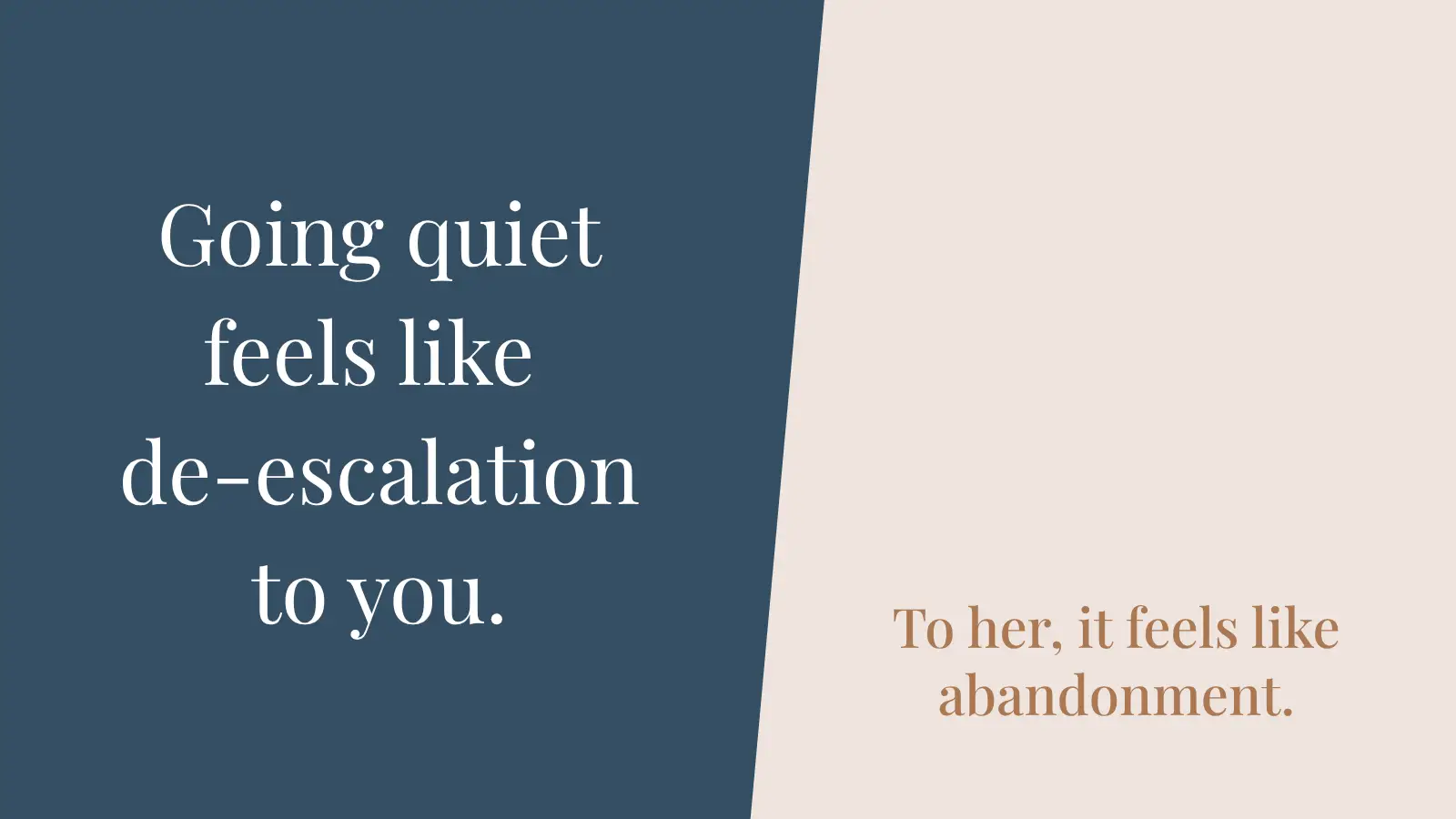
When you go quiet during conflict, you're not pressing pause. You're sending a signal. You may intend that signal to mean "I'm overwhelmed and need time to think." She receives it as "I don't matter enough for him to try."
That's not fair. But fairness isn't the point right now. The point is understanding the actual effect of your behavior, so you can decide whether you want to keep producing that effect.
Most men who shut down believe they're being considerate. They don't want to say the wrong thing. They don't want to escalate. They've been told or they've learned that silence is safer than words they'll regret. In the short term, that's true. In the long term, consistent silence trains your partner to feel alone inside the relationship.
The intimacy connection here is direct. Physical closeness requires emotional safety. Emotional safety requires knowing your partner won't disappear when things get hard. When you go silent in conflict, you're communicating the opposite: "When it gets hard, I leave." She can't feel safe enough to be warm and open with a man who might vanish the moment she needs him to stay.
She doesn't need you to have the right answer. She needs you to not disappear. That's a much lower bar than you've been setting for yourself.
the skill
The biggest mistake men make when they learn they're withdrawing too much is they try to solve it by saying more. More explanation. More processing. More talking through their feelings in real time, which for most men in their 40s is not something the nervous system does naturally under stress.
You don't need to say more. You need to say something. Specifically, you need one short sentence that does two things at once: buys you time, and keeps the connection open. This is a bridge phrase.
A bridge phrase is not a solution. It's not a repair. It's a signal that you're still here. That you haven't left. That the conversation isn't over.
Here's how it works in four moves:
Move 1 - Notice the flood before it takes over. Most men don't realize they've shut down until they're already gone. Start watching for the earlier signal: your jaw tightens, your chest closes, you stop tracking her words and start tracking exits. That's your cue.
Move 2 - Buy time with a real sentence. Not "I'm fine." Not silence. A bridge phrase that names what's actually happening: "I'm getting overwhelmed and I need a few minutes to think." This is not weakness. It's information she can work with.
Move 3 - Stay physically present where you can. If you need to step out of the room, say when you're coming back and follow through. If you can stay in the room, stay. Your physical presence tells her you're not abandoning the conversation.
Move 4 - Re-enter with something, not silence. When you come back, lead with what you noticed, not what you decided. "I've been thinking about what you said" is more connecting than a solved answer dropped into a cold room.
This is not therapy. This is mechanics. These four moves interrupt the cycle before it locks in.
what to say
Every script below is built for a real moment, under real stress. They're not meant to be elegant. They're meant to be usable. Read them before you need them so your brain has somewhere to go when the flood hits.
Scenario: The argument is escalating. You feel your mind shutting down. You haven't gone fully silent yet, but you're close.
Setup: Slow down physically before you speak. Lower your shoulders. Look at her, not at the floor or the wall.
"I want to keep talking about this. I'm having trouble thinking right now."
[Pause. Let that land.]
"Can you give me five minutes? I'm coming back to this."
Why it works: You've named your state, which takes you out of your head and into the room. You've told her you're not abandoning the conversation. That one line, "I'm coming back to this," does more work than most men realize.
What happens next: She may be frustrated. That's okay. Your job in this moment is not to resolve the frustration. Your job is to not disappear. If you come back in five minutes like you said you would, you've done the most important thing.
Scenario: She's upset and needs you to say something. Your mind is blank. You have nothing. You're reaching for words and finding only static.
Setup: Don't wait until you have the right thing to say. Say the true thing right now, even if it's uncomfortable.
"I don't know what to say right now. That doesn't mean I don't care."
[Stay in the room. Don't reach for your phone.]
"Can you tell me more about what you're feeling? I'm here."
Why it works: You've told her you're wordless, which takes the silence out of the interpretation zone. It's no longer "he's choosing not to respond." It's "he can't find the words but he's staying." That's a completely different signal.
What happens next: She may start talking more. Let her. Your job now is to listen, not to prepare your next line. When she pauses, say "okay" or "keep going." Those two words keep the conversation moving.
Scenario: You've been quiet for too long. She's shut down too, or she's still pushing. You know you need to come back but you don't know how to re-enter.
Setup: Don't wait for the perfect moment. Pick a moment and re-enter it.
"I shut down earlier and I'm sorry I went quiet like that. I wasn't done with the conversation."
[Pause. Let her respond or not.]
"I've been thinking about what you said. Can we try again?"
Why it works: You've named the behavior, which means she doesn't have to. You've told her the conversation still matters. "Can we try again" is one of the most useful phrases in conflict repair because it signals willingness without pressure.
What happens next: She might say yes immediately. She might need more time. Either way, you've opened the door. Don't force it open. Just leave it open and let her move toward it at her own pace.
Scenario: She's escalating because your silence is activating her fear of abandonment. The louder she gets, the more flooded you become. It's a pressure cooker.
Setup: Lower your voice deliberately. Don't match her volume. Keep your body still.
"I hear that you need me to say something. I'm not gone."
[Pause. Breathe. Lower your shoulders.]
"I need to slow down right now or I'm going to say something unhelpful. I'm not shutting you out."
Why it works: Her escalation is fear, not attack. She's pushing harder because she's trying to reach you. When you say "I'm not gone" and "I'm not shutting you out," you're answering the fear, not the argument. That's what actually lowers the temperature.
What happens next: Her volume may drop. It may not. Either way, stay low and steady. Your calm is doing something even when the argument is still hot.
Scenario: The argument has passed. Things have cooled down but nothing was really resolved. There's a distance in the room. You want to close it without opening everything back up.
Setup: Don't wait until bedtime. Do this within a few hours, when the sharp edges are dull but she's still aware of what happened.
"I want to check in about earlier. I know I went quiet and I don't want us to leave it there."
[Wait. Let her respond before you continue.]
"Are you okay? I mean actually okay, not 'fine.'"
Why it works: Most post-argument check-ins fail because they're actually bids to confirm the problem is over. This one is different. You're asking about her state, not the argument's resolution. That distinction matters. She feels seen instead of managed.
What happens next: This is usually where the real conversation starts. Keep your voice low. Don't defend. Don't explain your silence at length. Be curious about what she experienced. That curiosity is the thing that reopens intimacy after a shutdown.
your communication style
The five scripts above work for most men. But your default communication style affects how hard it is to use them, and what you need to watch for. Here's how to adjust.
Your strength is that you don't escalate. You don't say things in anger you'll regret. But your silence is doing damage you may not see in the moment. The Withdrawer's specific work is not to say more, but to say something sooner. Your default is to wait until you have something worth saying. Drop that standard in conflict. One sentence that names your state is worth more than ten minutes of processing.
The bridge phrase is built for you. Use it early, before you're fully flooded, and commit to the return time you give her.
Your pattern may look different: you stay present, but you don't say what you actually think. You agree, you smooth things over, and then two days later she can tell something is off and you can't quite name it. The scripts still work for you, but the adaptation is different: when she needs you to talk, give her your real position, not the one that keeps the temperature down. "I don't know what I think yet" is more honest than "whatever you think is fine." She needs to feel she's talking to someone, not talking at a mirror.
Your instinct under pressure is to explain or counter, not to disappear. But sometimes that defense comes out as quiet hostility, clipped answers, or a kind of cold silence that's different from the Withdrawer's but lands just as hard on her. The adaptation for you: when you feel the urge to explain yourself, try one line of acknowledgment first. "I hear you saying that" buys you time and keeps the conversation from locking into a standoff. You don't have to agree. Just show you heard her.
Your pattern in conflict is probably not silence, but if your partner shuts down in response to your intensity, the dynamic starts to look like the pursue-withdraw pattern in reverse. The scripts still apply: when she goes quiet, lower your volume, not increase it. "I can see I'm coming on too strong. Let me try that differently" keeps you present without scaring her back into herself.
how she responds
Your behavior in conflict doesn't happen in a vacuum. Her pattern shapes what you need to do next. Here's how to read it.
when it goes sideways
Sometimes you'll try the bridge phrase and she'll keep pushing. Sometimes you'll re-enter and she'll say "forget it." Sometimes the whole attempt will feel stilted and wrong. Here's what to do.
Repeat the bridge phrase. Say "I'm not leaving the conversation, I need five minutes" again, calmly. If she continues, leave the room briefly but say where you're going and when you'll be back. "I'm going to the kitchen. I'll be back in ten." Then be back in ten. The re-entry is what she'll remember.
Don't let it sit overnight if you can help it. A short, low-pressure check-in before bed, even one sentence, does more than a full conversation the next day. "I don't want to go to sleep with this unfinished" is a sentence that costs you nothing and signals everything.
That will happen. The pattern doesn't change in one conversation. What matters is what you do after. Name it: "I did it again. I went quiet." Don't over-explain. Don't promise you'll be different. Just name it and ask if you can try once more. The willingness to keep trying is more reassuring to her than any single perfect performance.
the intimacy payoff
If you've been in a pursue-withdraw pattern for a while, the sexual and emotional distance probably feels like a separate problem. It's not. They're the same problem.
When you shut down in conflict, she experiences it as emotional abandonment. Her nervous system learns: this relationship is not a safe place to be open. That learning lives in her body. It affects how available she feels to you physically. It affects whether she reaches for you in small ways, touches your arm, leans in, laughs easily around you.
When you start staying present, even imperfectly, that changes. Not instantly. But consistently. She starts to experience the relationship as a place where she won't be left alone when things get hard. Her nervous system begins to relax. And physical and emotional openness follow that relaxation.
This is not a transaction. You don't stay present in order to get sex. You stay present because the person you're with deserves a partner who doesn't vanish under pressure. The closeness that follows is the result of that, not the reward.
You can't stop shutting down in arguments overnight. But you can start interrupting the pattern before it runs its full course. That's enough to change the direction.
mistakes to avoid
This is the most common version of withdrawal. You're not gone, you're preparing. But from her side, it looks identical to not caring. The standard to aim for is not perfect words. It's something real, said imperfectly, in the moment.
When she's upset and you respond with a reasoned explanation of why the situation isn't actually a problem, you're not helping. You're retreating into logic because it feels safer. She doesn't need the situation explained. She needs to feel less alone in it. Acknowledge the feeling first. The logic can come later if it's still needed, which it often isn't.
The bridge phrases in this guide don't work if you read them once and then hope they show up when you're flooded. Practice them. Say them out loud when you're calm. Build the muscle memory before the next argument, not during it.
success check
Progress with this pattern doesn't look like perfectly resolved arguments. It looks like this:
That last one is the intimacy signal. Watch for it. It'll tell you that what you're doing is working before either of you names it.
dig deeper
The following sources inform the research base behind this guide. All are publicly available.
Note: This content is educational and not a substitute for therapy or professional advice. If the conversation involves coercion, fear, ongoing emotional harm, or safety concerns, seek support from a qualified professional.
Your Questions Answered
Shutting down during arguments is a physiological response called flooding. Your heart rate spikes under emotional stress and your brain's language centers go offline. It's not a character flaw. But it does damage the relationship if you don't learn to interrupt it with a short bridge phrase before you fully disappear. The good news is that flooding follows a pattern you can learn to spot early, before you've lost access to words entirely.
You don't need the right words. You need one sentence that keeps the connection open. Try: "I'm getting overwhelmed and I need a few minutes. I'm coming back to this." That sentence tells her you're not abandoning the conversation and gives your nervous system time to recover. The return matters as much as the bridge phrase itself, so commit to a specific time and follow through.
Men tend to flood faster during conflict and recover more slowly than women, according to Gottman's research. Going silent is the nervous system's way of avoiding an escalation it can't handle. It's not indifference. But from your side of the argument, it can feel like abandonment, which often triggers more pursuit, which triggers more withdrawal. The cycle escalates until one person learns to interrupt it.
Start watching for the early warning signs before you're fully flooded: jaw tension, chest tightness, losing track of what she's saying. When you notice those signals, use a bridge phrase immediately. "I need a few minutes but I'm coming back to this" is more useful said early than any explanation given after you've already gone silent. Practicing the phrase out loud when you're calm helps it show up when you're under pressure.
Yes, directly. When you shut down in conflict, she experiences it as emotional abandonment. Her nervous system learns the relationship isn't a safe place to be open. That affects physical closeness, small affectionate gestures, and her willingness to reach for you. Staying present in arguments, even imperfectly, is one of the most direct paths to rebuilding that closeness.
Based on what you just read, these related guides may also be helpful.
Get the weekly script
Get one practical phrase each week for talking about intimacy, desire, rejection, and repair without blame.
No spam. Unsubscribe anytime.
Share respectfully below. Comments are moderated before appearing.
No credit card required.