
Get the weekly script
Get one practical phrase each week for talking about intimacy, desire, rejection, and repair without blame.
No spam. Unsubscribe anytime.
Why limits create safety for men who fear standing up for themselves will make things worse
14 min read
You know exactly what you want to say to your wife, and you swallow it, again. Maybe it's a no you don't feel safe giving, a limit on how she talks to you when she's upset, or a request for a few hours to yourself that you're sure will sound selfish. If you're afraid to set boundaries with your wife because you think it will push her further away, you're carrying a fear that doesn't match what tends to happen when men do this well.
Key Takeaways:
put this into practice
Use these companion tools below when you are ready to have your real conversations.
why this feels risky
For a lot of men, this fear didn't start with your wife. It started earlier, with a parent who went cold when you disagreed, an ex who punished pushback with days of silence, or a house where keeping the peace was the only way anyone felt safe. You learned that naming a need cost you something, so you stopped naming them. That pattern kept you steady for years. It just never taught you what to do once staying quiet stopped being enough.
Now the thought of saying "that doesn't work for me" or "I need this to stop" feels like pulling a thread that could unravel everything. Your body reacts before your mind catches up. Your chest gets tight. You rehearse the sentence, then talk yourself out of it before you've said a word.
You're afraid to set boundaries with your wife because somewhere along the way, having a limit meant losing someone. That's a real memory. It just isn't a reliable prediction of what happens now.
the real cost of staying quiet
Every time you say yes when you mean no, you're making a small deposit into a resentment ledger she never sees. She doesn't see the tally build. She just notices, over months, that you seem a little further away than you used to be.
There's a second cost too. When you never push back, she loses a way to trust what you tell her. If your agreement never has an edge to it, she can't tell the difference between what you really want and what you're just allowing to keep things smooth.
Researchers who study closeness call this perceived partner responsiveness, the daily felt sense that your partner truly sees you, values you, and supports the real you, not a version you've smoothed over to keep the peace (Reis, Clark, & Holmes, 2004). She can't feel fully responded to by someone whose honest reactions she rarely gets to see.
the shift that changes this
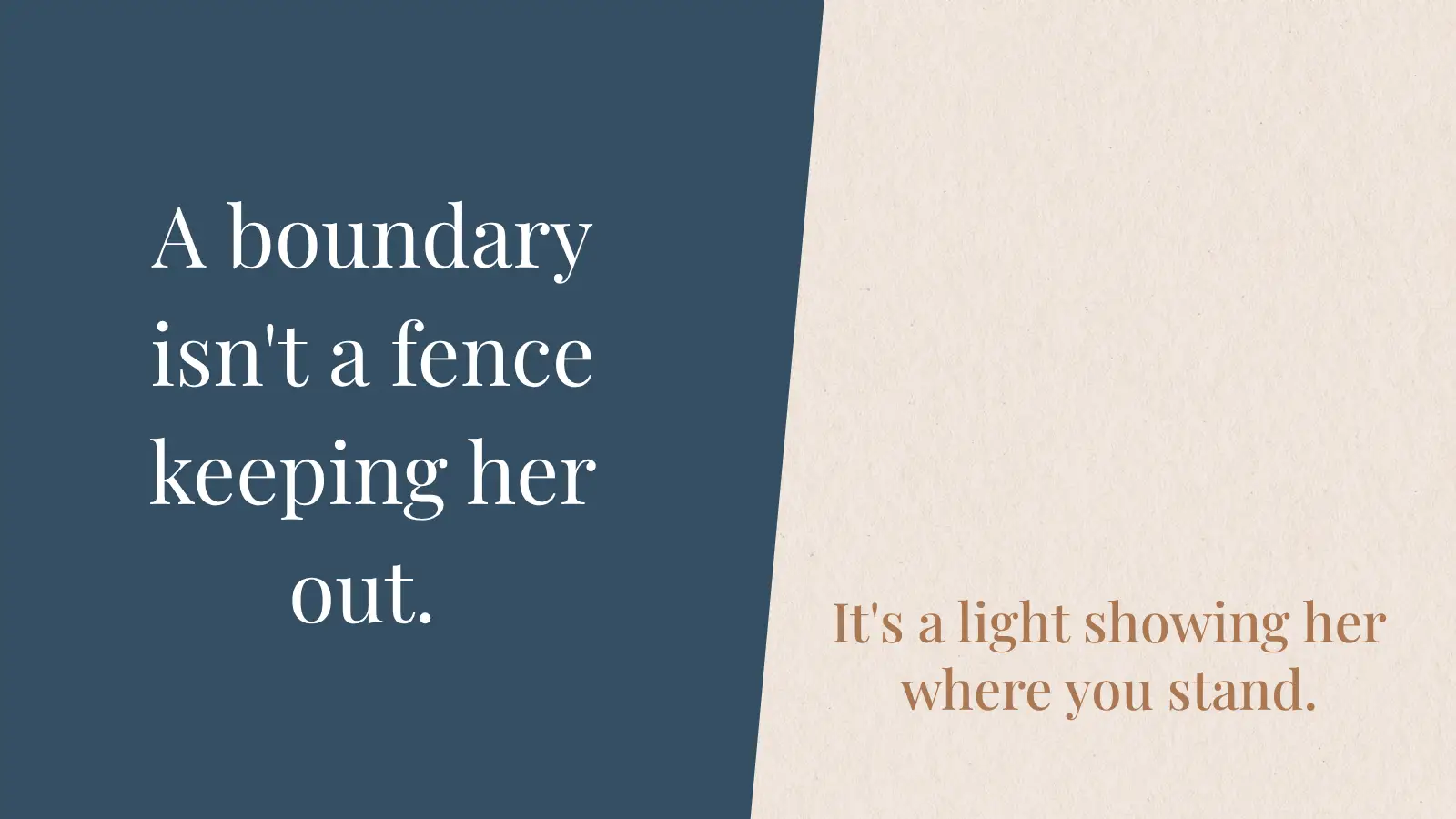
A boundary isn't a wall you put up to keep her out. It's information you hand her about what's true for you, so she isn't left guessing at a version of you that doesn't exist. Used well, a limit builds the exact kind of safety that makes closeness possible, instead of the kind that quietly erodes it.
Step 1 - Find your resentment ledger. Notice where you've already said yes to something that cost you more than it should have. Write down two or three of these. This tells you where your first boundary belongs.
Step 2 - Separate the fear from the pattern. Ask yourself what you expect will happen if you push back, then compare that to what has happened the handful of times you've tried it before. Most men are running on one bad memory, not a real track record.
Step 3 - Pick one boundary, small and specific. Choose a single limit you can hold this week, not a list of every grievance you've collected. A specific ask is easier to say and easier for her to hear than a pile of complaints.
Step 4 - Say it in plain, low-drama language. Use short, direct sentences. Skip the apology tour before and after. State it once, calmly, and let it stand.
what to say
Scenario: She asks you to take on something, hosting her family again, another weekend commitment, and your automatic answer is yes, even though you're already stretched thin.
Setup: Say it in the same conversation where she asks, before resentment has time to build around it.
"I want to be honest instead of just going along with this."
Pause here, and let it sit for a second.
"I can't take this one on right now. Can we figure out another way to handle it?"
Why it works: You're naming your limit without a list of justifications behind it, which keeps the moment short instead of turning into a debate about whether your reasons are good enough.
What happens next: She may push back once, or she may simply ask what would work better. Either way, hold the boundary instead of restating your case five different ways.
Scenario: She raises a complaint by yelling, or the tone turns sharp fast, and you usually either go silent or match her volume.
Setup: Wait for a calm moment, not the middle of a heated exchange, to name this pattern.
"I want to hear what's bothering you, every time."
Take a second before you carry on.
"I have a harder time hearing it when the volume goes up. Can we try saying it at a regular volume, even the hard stuff?"
Why it works: This asks for a change in delivery, not a change in her feelings, so it reads as a request for a workable process rather than an attempt to shut her down. She may still read it as you trying to control the conversation, so pair it with the first line every time, so she hears that you still want the whole truth, just at a volume where you can stay in the room for it.
What happens next: She may test this once to see if you mean it. Stay consistent instead of caving the first time her voice rises again.
Scenario: You have one evening or activity a week that matters to you, training, a hobby, time with friends, and it keeps getting quietly eaten by other obligations.
Setup: Bring this up outside the moment it's being threatened, as a standing agreement rather than a one-time favor.
"Tuesday nights matter to me more than I've been showing you."
Just breathe for a moment before you carry on.
"I want to protect that time going forward. Can we plan around it instead of around whether I can make it work each week?"
Why it works: You're asking for a standing agreement instead of permission each week, which removes the negotiation from every single instance.
What happens next: Expect one or two tests where something else tries to claim that time. Hold the line calmly rather than explaining yourself again.
Scenario: You've become the default person for something, finances, discipline, the hard conversations with in-laws, and you agreed to it once, years ago, without meaning to sign up for good.
Setup: Bring this up as a shared problem to solve, not a complaint about her.
"I've been the default on this for a long time, and it's worn on me more than I've said."
Pause here, and let it sit for a second.
"I'd like us to split this differently. Can we figure out a way that works better for both of us?"
Why it works: Naming the pattern as something to redesign together, instead of an accusation, gives her a reason to problem-solve with you instead of defending the current setup.
What happens next: She may feel some initial guilt or defensiveness. Stay with the request instead of backing off the first time it feels uncomfortable.
Scenario: You already said yes to something, and you're realizing now that it doesn't work for you the way you thought it would.
Setup: Circle back as soon as you notice it, rather than gutting it out and building resentment.
"I said yes to this, and I'm realizing it doesn't work for me the way I thought."
Take a second before you carry on so it has time to sink in.
"Can we find another option together?"
Why it works: This treats your earlier yes as information rather than a mistake to hide, which keeps the conversation about solving a problem instead of confessing a failure.
What happens next: She may be surprised or briefly frustrated that this is coming up now. Stay calm and repeat the request for another option rather than over-apologizing for changing your mind.
your communication style
If you tend to agree just to keep things calm: This is likely the pattern driving most of what you've read so far. Your habit is saying yes and hoping the resentment doesn't show. Practice the first script on something small before you try it on something bigger. She may read your first real boundary as you pulling away, when it's closeness done honestly for the first time in a while.
If you tend to defend yourself the moment she raises an issue: Boundaries work differently for you. Your risk isn't staying silent, it's turning every limit into a case you have to win. Try stating it once, without listing evidence for why you're right, then stop talking.
If you tend to raise your voice or push harder when you feel unheard: Your boundary work starts with volume, not wording. State the limit at half the intensity you feel inside, since your intensity can overshadow a reasonable request before she even hears it.
If you tend to go quiet and leave the room under stress: Your risk is turning a boundary into another disappearance. Say the limit out loud before you take space, and name that you're staying in the room for it, even if you need a minute right after.
how she might respond
what not to say
Over-explaining. Stacking five reasons behind one no reads as asking for permission rather than stating a limit.
Apologizing repeatedly. Saying sorry before and after the boundary undercuts the very thing you just said.
Using the boundary as a weapon. Bringing it up mid-argument to win a point, instead of stating it as a standing need, turns a limit into ammunition.
Waiting until resentment explodes. Letting the ledger build for months, then delivering ten boundaries at once during one fight, guarantees she hears anger instead of a request.
when it goes sideways
Some boundary conversations will go sideways no matter how well you say them. If she gets upset in the moment, resist the urge to take the boundary back right away to calm things down. You can soften your delivery without withdrawing the limit itself.
"I can see this hit hard for you, and I still mean what I said."
Wait here, and don't rush to fill the silence.
"Can we talk more about it tonight, once things have settled?"
Her sharp reaction right after a first boundary can feel like proof that you were right to be afraid, when it may simply be her adjusting to a version of you that's finally being direct with her.
the intimacy payoff
None of this is about winning arguments or getting your way more often. A clear, low-drama boundary tells her something true about you that she can trust completely. That kind of trust is what lets her soften her guard, physically and emotionally, in a way constant agreement never earns. Men who learn to hold a few honest limits often find their wives initiating warmth more, not less, because she finally knows where she stands with you.
You'll know this is working when you can state a small no without over-explaining it, when the resentment ledger gets shorter instead of longer, and when she starts treating your yes as something she can fully trust.
terms used in this guide
references
Your Questions Answered
No, the opposite tends to happen. A clear, calm boundary gives her something honest to trust, and trust is what lets her feel safe enough to be physically close. Constant agreement without any real limits is what usually erodes desire over time, not the other way around. Most men who try one small, specific boundary find she warms up within a few weeks instead of pulling away.
Start small and specific instead of unloading every grievance at once. Say the limit once, calmly, without a string of justifications, then let it stand. A short, honest boundary reads as confidence, and confidence tends to draw her closer rather than push her away. Skip the apology before and after it, since that's what usually turns a confident ask into a confusing one.
When you agree to everything, she can no longer tell what you really want, so your yes stops meaning anything to her. That uncertainty quietly wears down trust and warmth, even when nothing dramatic ever happens between you. She ends up guessing at the real you instead of responding to him.
Pick a calm moment instead of the middle of tension, and state the limit in one or two plain sentences without repeating yourself. Skip the apology tour before and after it, since over-explaining is what usually turns a simple boundary into an argument. A short, direct line leaves far less room for a fight to grow out of it.
Look for the smallest yes you've been giving that you already resent, and start there instead of your biggest grievance. A small, specific boundary you can hold consistently rebuilds trust faster than one dramatic conversation ever could. That one small change is often enough for her to notice something has shifted.
Note: This content is educational and not a substitute for therapy or professional advice. If the conversation involves coercion, fear, ongoing emotional harm, or safety concerns, seek support from a qualified professional.
Based on what you just read, these related guides may also be helpful.
Share respectfully below. Comments are moderated before appearing.
No credit card required.