
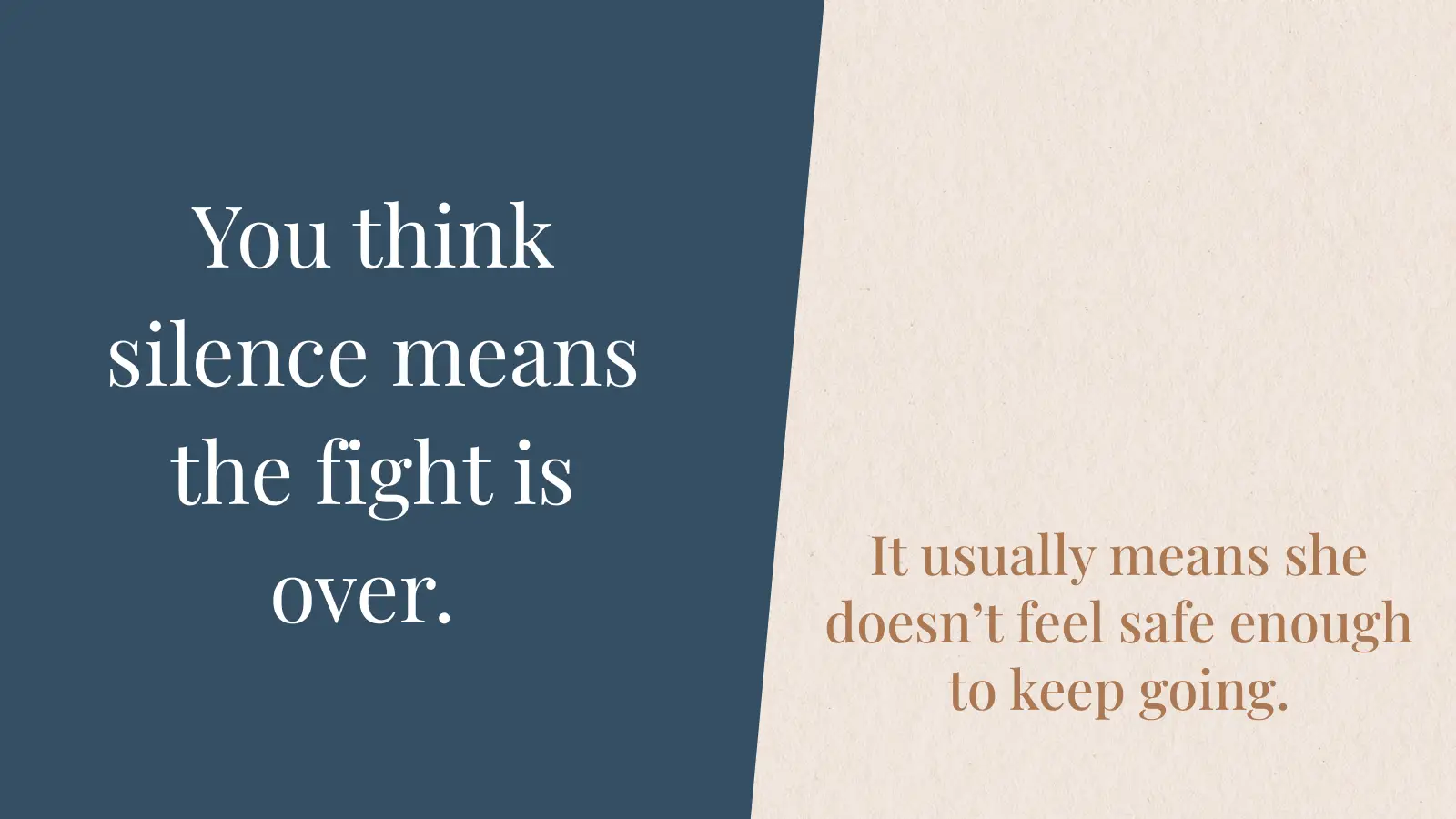
What to Do When She Shuts Down Mid-Conversation
Simple cues and scripts for men who keep talking when she’s already overwhelmed
13 min read
You’re three sentences into making your point and something’s off. Her answers have gone short. Her eyes aren’t on you anymore. This is what it looks like when she shuts down mid-conversation, and if you keep talking right now, you’re probably making it worse, not better.
Key Takeaways:
- Learn the five cues that appear before she goes fully silent, so you can catch it early instead of after the fact.
- Use a short method for pausing and offering a real break, with a real time to come back to the conversation.
- Get scripts built for the moment she’s already stopped answering, not just the moment right before it.
TURN INSIGHT INTO ACTION
This guide gives you the understanding.
Below are practical tools to help you as you work through the topic.
- Playbook: for step-by-step practice
- Checklist: to keep handy during a real conversation
- Quiz: to identify your communication pattern
- AI Coaching: to help you rehearse, reflect and stay on track
AI COACHING
Help Me Notice When She Shuts Down
If you are already using AI, try the prompt that asks about your specific
relationship. The advice will reflect your individual situation, not
someone else’s.
what’s really happening
Why You Keep Talking When She’s Already Gone
Here’s the pattern. You’re in the middle of something, maybe small, maybe not, and you notice she’s stopped really answering. Instead of stopping too, you keep going. You explain it a different way. You add one more point. You ask the same question again, just softer this time.
None of that is cruelty. It’s usually the opposite. You’re trying to fix it before it gets worse, and stopping mid-sentence feels like giving up, or like leaving something broken overnight. So you push through, and that’s exactly when she shuts down further instead of coming back around.
This instinct usually comes from somewhere specific. A lot of men grew up in houses where things only got resolved if someone kept pushing until the other person answered. Silence meant you’d lost, not that the conversation was paused. Some men learned this in an earlier relationship, where going quiet themselves once cost them, so now stopping feels dangerous even when it’s her turn to need the pause.
Either way, the fear underneath it is usually the same one: if I stop now, this never gets resolved. That fear is understandable. It’s also the exact thing that keeps you talking past the point where she can hear you at all.
the five cues
Five Cues That Show Up When She Shuts Down
Most men catch the shutdown after it’s already happened. These five cues usually appear first, often within the same minute or two.
- Her answers get shorter. “I don’t know” or “sure” instead of a real sentence back.
- Eye contact drops. She looks at the counter, the floor, or her phone instead of you.
- Her tone flattens. Whatever emotion was in her voice a minute ago is gone, replaced by nothing.
- She creates physical distance. Turning her body slightly away, crossing her arms, stepping back toward the doorway.
- She stops asking anything back. A conversation that had questions going both ways becomes entirely one-sided, yours.
Any one of these on its own might mean she’s just tired. Two or three together, in the middle of a hard conversation, usually means she’s already checked out and is trying to hold herself together until it ends.
why talking more doesn’t help
Why Pushing Through Backfires
When she shuts down, her heart rate has usually spiked and her ability to take in more words has already dropped. Gottman calls this flooding, and the research behind it shows that once someone crosses that point, more talking doesn’t get through. It just adds noise to a system that’s already overloaded.
You can usually feel a version of this yourself. Heart racing a little, throat tight, that urge to either explain harder or walk away. She’s often somewhere similar, except she’s also trying to track everything you’re saying at the same time. That combination is what pushes her from quiet into fully shut down.
Here’s the part most men miss. Talking louder or faster doesn’t reopen the door. It just confirms to her that stopping isn’t an option, which makes the shutdown deeper and longer. The fastest way back into the conversation is almost always to stop adding to it first.
the method
The Notice-and-Return Method
This is a short sequence for the moment you catch one of the five cues. It’s five steps, and you can move through all of them in under a minute.
Step 1 – Notice. Catch at least one of the five cues without commenting on it yet. Just register it to yourself: she’s going quiet.
Step 2 – Pause. Stop talking mid-thought if you have to. An unfinished sentence is fine. A wall of new points is not.
Step 3 – Name it. Say what you’re seeing, briefly and without blame, so she knows you noticed instead of guessing she imagined it.
Step 4 – Offer a real break. Give her an actual window of time, not a vague “we’ll talk later.” A specific hour works better than an open-ended promise.
Step 5 – Return on time. Come back when you said you would, even if you’d rather avoid it. This is the step that builds trust for the next time this happens.
what to say
What to Say When She Shuts Down
Script 1: Catching It Early
Scenario: You’re mid-conversation about something ordinary, a schedule, a bill, a plan for the weekend, and you notice her answers shrinking to one word.
Setup: Stop before you finish your current point. Keep your voice at normal volume or lower.
“Hey, you went quiet. Do you want a minute, or should I keep going?”
Wait for her answer before continuing.
“Either way is fine. I just wanted to check.”
Why it works: You’re naming the shift instead of talking over it, and you’re handing the pace back to her instead of deciding for both of you.
What happens next: She may say she’s fine and keep going, or she may need the minute. Either answer is useful information.
Script 2: When She’s Already Stopped Answering
Scenario: A harder conversation, finances, in-laws, something from years back, has gone on for fifteen minutes and she’s stopped responding, staring at the counter.
Setup: Lower your volume before you speak. Give her physical space if you’ve been standing close.
“I can see you’re done for right now. I’m going to stop pushing on this.”
Take a breath before you continue.
“Can we come back to it around eight tonight?”
Why it works: This can feel to her like the first sign of safety she’s had in the whole conversation, since it removes the pressure to keep responding while overwhelmed.
What happens next: She may nod, walk away without answering, or say a quiet okay. Any of these means the break has started.
Script 3: Slowing Yourself Down First
Scenario: You notice the shutdown starting and feel your own urge to push harder before you’ve said anything else.
Setup: This one is mostly internal, followed by a short line out loud.
[Tell yourself] “She’s not shutting me out to punish me. She’s out of room to take anything else in right now.”
[Then say] “Let me slow down for a second.”
Why it works: The internal reframe changes what you do next before it turns into another five minutes of pushing.
What happens next: You’ll usually notice your own volume and pace drop, which she’ll pick up on even if she doesn’t say anything.
Script 4: Coming Back After the Break
Scenario: The window you set has arrived and you’re ready to pick the conversation back up.
Setup: Approach when she’s not mid-task if you can help it. Keep it short.
“You said you needed some space earlier. I’ve got time now if you do.”
Let the sentence sit before adding anything else.
“No pressure if it’s not the right moment.”
Why it works: Showing up on time, without demanding she engage immediately, does more to rebuild trust than the original topic ever will in that moment.
What happens next: She may pick the conversation back up right away, ask for a bit more time, or bring it up herself later that night.
Script 5: Repairing After You Pushed Too Hard
Scenario: You missed the cues earlier and kept talking well past the point she’d already shut down.
Setup: Bring this up later, once things are calm, not as another round of the original topic.
“I want to go back to earlier. I kept talking after you’d already checked out, and that wasn’t fair to you.”
Pause and let that land before continuing.
“Next time you go quiet, I’ll try to catch it faster.”
Why it works: Naming the specific mistake, without re-litigating the original issue, gives her something concrete instead of a vague apology.
What happens next: She may soften noticeably, stay guarded for a while longer, or test whether you follow through next time.
what not to say
What Not to Say
A few things reliably make a shutdown worse, even when they come from a good place.
- “You’re overreacting.” This reads as an attack on her state itself, which deepens the retreat instead of ending it.
- “Can we just finish this?” This treats her overwhelm as an inconvenience to your schedule, not something real happening to her.
- “Fine, whatever.” This can feel like abandonment mid-conversation, which is different from an honest, timed pause.
- Repeating the same point louder. Volume doesn’t get past a shutdown. It just confirms to her that stopping isn’t safe yet.
your communication style
How to Adapt, By Your Communication Style
Most men default to one pattern under stress, and that pattern shapes how you tend to handle her shutting down.
| If this is your pattern | What to watch for and adjust |
|---|---|
| Connector | You tend to reassure repeatedly, “it’s okay, we’re okay, I’m not upset,” stacked one after another. To her, that can sound like pressure to respond before she’s ready. Say one reassuring line, then let the silence hold. |
| Defender | Her shutdown can feel like she’s shutting you out unfairly, so you list what you did right instead of pausing. Stop the list, name what you see, and step back before adding your side. |
| Escalator | You raise volume or pace to get a reaction, mistaking intensity for connection. Lower your voice on purpose, on a single line, then stop talking entirely. |
| Withdrawer | You tend to mirror her shutdown by going quiet yourself, which leaves both of you silent with no path back. You’ll need to be the one who initiates the short check-in, even though your instinct is to disappear too. |
her pattern
How to Adapt, By Her Pattern
Her general pattern under stress also shapes what she needs from you once she’s shut down in the moment.
when it goes sideways
When It Goes Sideways
Sometimes you’ll catch the cues late, or she won’t respond to the offer of a break at all. If she says something like “don’t bother, it doesn’t matter anyway,” don’t argue the point. Say, “It matters to me. I’m not going to push right now, but I’m not dropping it either. I’ll check back at eight.”
If the return time arrives and she’s still not ready, don’t treat that as a failure of the method. Ask for a new time instead of reopening the original topic on the spot. This can feel to her like proof that you’ll wait instead of forcing the timeline to suit you.
the intimacy payoff
The Intimacy Payoff
Catching a shutdown early and handling it well does more for closeness than almost anything you can say mid-argument. When you stop pushing at the right moment, she may read that as proof you can be trusted with her hardest moments, not just her easy ones. That’s what rebuilds the safety that affection and desire depend on.
Short term, you’ll likely notice less flinching the next time a hard topic comes up, and a bit more warmth once the break is honored. Longer term, repeated proof that you notice and pause, instead of pushing through, is what lets physical closeness come back on its own timeline instead of being forced.
how to know it worked
THE SUCCESS CHECK
- She responds to your check-in instead of staying completely silent.
- The conversation, or a related one, gets picked back up within a day, instead of disappearing entirely.
Did your partner seem more or less defensive after you used this script?
terms used in this guide
Glossary
- Flooding: A physical stress response, racing heart, tight chest, where it becomes hard to take in more words or think clearly during conflict.
- Stonewalling: Withdrawing from a conversation entirely, going silent or physically leaving, usually as a response to feeling overwhelmed.
- Notice-and-Return Method: The five-step sequence in this guide, catching the cues, pausing, naming it, offering a real break, and returning on time.
when you want to dig deeper
References & Books
- The Seven Principles for Making Marriage Work. Gottman, J. M., & Silver, N. (1999/2015). Harmony Books. Introduces the Four Horsemen, including stonewalling, and the research behind why flooding shuts conversations down. Source link | Amazon
- The Marriage Clinic: A Scientifically Based Marital Therapy. Gottman, J. M. (1999). W. W. Norton & Company. Lays out the physiological flooding research behind the 100 BPM rule referenced in this guide. Source link | Amazon
- Attachment in Adulthood: Structure, Dynamics, and Change. Mikulincer, M., & Shaver, P. R. (2007). Guilford Press. Explains why some partners use silence as a way to deactivate an overwhelming interaction rather than as rejection. Source link
- The Gottman Method: Clinical Overview. The Gottman Institute (2025). Explains physiological flooding, the heart rate threshold involved, and the twenty-minute reset window referenced in the method above. Source link
AI COACHING
Ready to Work This Through?
Use the AI Coaching Companion to rehearse what you want to say,
question your assumptions and prepare for the real conversation.
KEEP GOING
Choose Your Next Step
Use the Playbook for step-by-step practice, keep the Checklist handy
during a real conversation, or take the Quiz to identify your
communication pattern.
Your Questions Answered
Frequently Asked Questions
What does it mean when she shuts down and stops wanting to be touched?
It usually means she’s overwhelmed, not that she’s lost interest in you. Her body is still working through a stress response, so touch can feel like more input instead of comfort right now. Give her time to reset before you try to reconnect physically. Pushing for affection right after a shutdown tends to make her pull back further, even if that’s not what you intend.
Why does she pull away from sex after we argue and she goes silent?
When she’s shut down, her body is still in a stress response, and desire doesn’t return until that settles. Rushing toward sex or affection too soon after can feel like pressure instead of comfort. Give the conversation a real repair first, even a short one, before you look for physical closeness again.
How long does it take for physical closeness to come back after she shuts down mid-conversation?
There’s no fixed timeline, but most women need the conversation to feel resolved, even briefly, before physical closeness feels safe again. A short, calm return to the topic usually helps more than waiting in silence and hoping it passes on its own. Small gestures work better than forcing a big reconciliation in one sitting.
How do I bring up physical closeness again after a shutdown without pushing her?
Name what you noticed without blame, and ask if she has time to finish the conversation. A short check-in like this often does more for closeness than jumping straight to affection or assuming things are fine. Let her set the pace for anything physical, since that’s usually what rebuilds trust fastest.
Is it normal to lose desire for each other after she shuts down during arguments?
Yes, it’s common for desire to dip for both partners after a shutdown, since stress hormones interfere with arousal on both sides. This fades once the underlying tension gets addressed instead of avoided or talked around. Repeated unresolved shutdowns, not one hard conversation, are what cause lasting distance over time.
Note: This content is educational and not a substitute for therapy or professional advice. If the conversation involves coercion, fear, ongoing emotional harm, or safety concerns, seek support from a qualified professional.
Have a thought or questions about this guide?
Share respectfully below. Comments are moderated before appearing.