
Why Being Vulnerable Actually Turns Her On
Concrete phrases for men who doubt emotional openness leads to physical desire
12 min read
If you’ve ever asked yourself whether being vulnerable turns her on or just makes you look weak, you’re already doing something most men skip. You’re questioning a story you were taught without ever agreeing to it: that strength means never showing what’s underneath. That story is costing you more than you realize. The women who feel safest getting close to a man aren’t drawn to the guy who never flinches. They’re drawn to the guy who’s honest about what’s actually going on inside him.
Key Takeaways:
- Learn the exact difference between vulnerability that draws her in and vulnerability that pushes her away.
- Get five ready-to-use phrases that open the door to desire instead of distance.
- Understand what actually happens in her body when you tell her the truth about yourself.
TURN INSIGHT INTO ACTION
This guide gives you the understanding.
Below are practical tools to help you as you work through the topic.
- Playbook: for step-by-step practice
- Checklist: to keep handy during a real conversation
- Quiz: to identify your communication pattern
- AI Coaching: to help you rehearse, reflect and stay on track
AI COACHING
Help Me Tell Grounded From Needy
If you are already using AI, try the prompt that asks about your specific
relationship. The advice will reflect your individual situation, not
someone else’s.
what’s actually happening
Why You Think Opening Up Will Cost You
You’ve probably absorbed one lesson without ever being taught it directly. Don’t show her the parts of you that aren’t handled. Fear, doubt, the sense that you might not be enough, all of it gets filed under things a man keeps to himself. It feels like protection. It feels like keeping things steady.
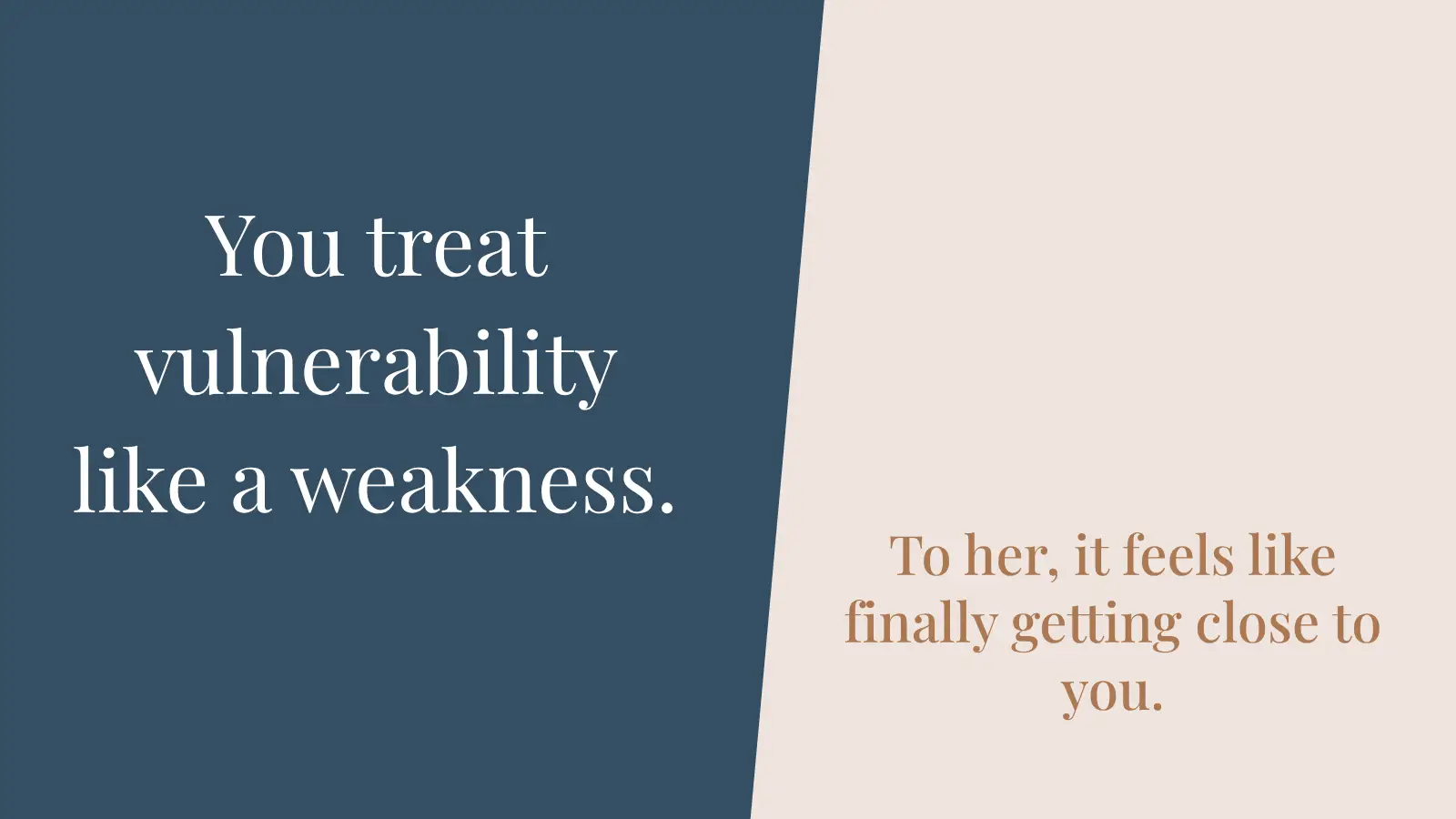
Here’s what that lesson leaves out. Staying handled all the time doesn’t read as strength to her. It reads as distance. She can tell the difference between a man who’s calm because he’s actually okay and a man who’s calm because he’s hiding something. Over time, that gap becomes the thing standing between you and her.
the real mechanism
What Vulnerability Actually Does To Her Body
Being vulnerable turns her on for a reason that has nothing to do with pity or sympathy. When you tell her something true, her nervous system gets new information. This man trusts me enough to show me what’s real. That sense matters more than most men think, because feeling understood and valued by you is one of the strongest predictors of whether she feels safe wanting you.
That safety is what lets her body relax instead of stay on guard. A relaxed body is what opens the door to desire, not just tolerance.
There’s a catch. Not all vulnerability works this way. If you share something true and then need her to fix it, comfort you, or prove she still loves you, you’ve turned honesty into a demand. That kind pushes her away instead of pulling her in. The version that works stays grounded. You say the true thing. You stay steady while she responds however she responds, without needing a specific reaction to feel okay about what you said.
the method
How To Open Up Without Losing Her Respect
Here’s how to do this without turning into someone she doesn’t recognize.
Step 1 – Name it to yourself first. Before you say anything to her, get honest with yourself about what you’re actually afraid of. Vague discomfort doesn’t turn into a workable script. A specific fear does.
Step 2 – Pick one true sentence. Not a paragraph, not a confession marathon. One sentence that’s actually true and actually hard to say out loud.
Step 3 – Say it plainly. Skip the qualifiers that soften it into nothing. “Maybe this is dumb, but” and “it’s not a big deal, but” both cancel out whatever comes after them.
Step 4 – Stay in your body while you say it. Keep your voice steady even if it shakes a little. Don’t rush to fill the silence right after.
Step 5 – Let her reaction be information, not a verdict. Whatever she does next tells you something useful about where she is right now. It doesn’t mean you did it wrong.
what to say
5 Phrases That Actually Spark Desire
When You’ve Never Said This Out Loud
Scenario: You want to tell her you’re scared you’re not enough for her, but you’ve never said it out loud.
Setup: Pick a quiet moment, not the middle of an argument. Sit close enough that she can see your face.
“There’s something I’ve never said out loud. I’m scared sometimes that I’m not enough for you.”
Just breathe here. Don’t fill the silence with a joke.
“I’m not saying this so you’ll fix it. I just don’t want to keep it from you anymore.”
Why it works: You name the fear instead of performing confidence, which gives her something real to respond to.
What happens next: She may go quiet for a second before she leans in. Let her.
Admitting You Miss Her
Scenario: The two of you have started feeling more like roommates than partners.
Setup: Choose a low-pressure moment, driving somewhere or right before bed.
“I miss feeling close to you. Lately it feels more like we’re sharing a house than sharing a life.”
Take a second before you carry on so it has room to sit.
“I don’t need you to say anything right now. I just wanted you to know.”
Why it works: This admits your want for connection without demanding a fix or an instant reply.
What happens next: She might get quiet, or she might reach for your hand. Either way, you’ve opened a door that was closed.
Admitting A Mistake Without Defending It
Scenario: You know you’ve been distant lately and she’s noticed.
Setup: Bring it up before she has to ask again.
“I’ve been checked out lately, and that’s on me, not you.”
Just pause and take a breath before you continue.
“I don’t have a good excuse. I just want you to know I see it.”
Why it works: You own the pattern instead of explaining it away, which removes the wall she usually has to push against.
What happens next: She may test you a little to see if you mean it. Stay with what you said instead of walking it back.
Naming Sexual Fear Out Loud
Scenario: You’ve been avoiding sex because you’re worried about performance.
Setup: Talk about it outside the bedroom, not in the moment.
“I’ve been avoiding this because I’m scared of disappointing you, not because I don’t want you.”
Wait here, and don’t fill the silence.
“I wanted you to know the real reason instead of letting you guess at one.”
Why it works: This replaces the story she’s probably built, that you’re not attracted to her, with the true one.
What happens next: She often softens quickly here, because this fear is one she rarely hears from a man directly.
Saying You’re Scared Of Losing Her
Scenario: Things have felt distant for a long time and you’re worried it’s becoming permanent.
Setup: Choose a moment when you’re not mid-conflict and you have her full attention.
“I’m scared we’re drifting into something we can’t come back from.”
Take a second before you carry on so it has room to sit.
“I don’t want to lose this. I wanted you to know that instead of just hoping you’d notice.”
Why it works: This shows her the stakes matter to you without blaming her for the distance between you.
What happens next: She may cry, get quiet, or ask what you want to do differently. All three mean she heard you.
your communication style
How To Do This Based On How You Communicate
If you tend to keep the peace and avoid rocking the boat: Your instinct is to skip the vulnerable admission because you’re worried it’ll create tension. But your silence reads as absence, not calm. Try telling her one true thing this week, even a small one. “I’ve been quieter than usual because something’s been on my mind” opens more than another “I’m fine.”
If you tend to get defensive when criticized: Your instinct is to explain or justify before you admit anything true. Try skipping the defense entirely. Say the vulnerable thing first, then stop talking. “I’ve been distant, and that’s on me” works better without a “but” attached to it.
If you tend to get loud or intense under stress: Your instinct is to turn vulnerability into a speech, piling on words until you’ve said too much. Try one sentence, said quietly, instead of five said fast. “I’m scared of losing you” doesn’t need a follow-up sentence to prove it’s true.
If you tend to go quiet or shut down under stress: Your instinct is to wait until you have the perfect words, which usually means you never say anything. Try saying the imperfect version now. “I don’t know how to say this right, but I miss you” is more honest than staying silent until you find the right words.
her likely response
How She’s Likely To Respond
before you start
Get Ready Before You Say Anything
Before you say any of this out loud, spend five minutes writing down what you’re actually afraid will happen if you’re honest with her. Then ask yourself if that fear is based on something she’s actually done, or something you’re assuming she’ll do. Most of the time it’s the second one.
Practice saying the sentence out loud, alone, before you say it to her. If it sounds stiff or rehearsed, cut words until it sounds like something you’d actually say to a friend.
when it goes sideways
When It Goes Sideways
If she brushes it off or says something like “okay” and changes the subject, don’t chase her for a bigger reaction. Give it a day, then say: “I know I brought something up yesterday and you didn’t say much. I just wanted you to know it’s still true.”
If she gets defensive or accuses you of trying to manipulate her into sex, don’t defend your motives. Say: “That’s not why I said it. I get why it might look that way. I still meant it.”
the intimacy payoff
The Intimacy Payoff
When you tell her something true about your fear or your mistakes, three things tend to happen. She stops guessing at a version of you that isn’t real. Her body relaxes a little, because she’s not bracing for a performance anymore. And over the next few days, you’ll likely notice smaller signs of closeness coming back: a hand on your arm, sitting nearer to you on the couch, more eye contact than usual. That’s not an accident. That’s what safety does to desire.
how to know it worked
THE SUCCESS CHECK
- She responds with more than one word, even if it’s a question.
- She’s physically closer to you within a day or two of the conversation.
Did your partner seem more or less defensive after you used this script?
when you want to dig deeper
References & Books
- Perceived Partner Responsiveness and Closeness. Reis, H. T., Clark, M. S., and Holmes, J. G. (2004). Perceived partner responsiveness as an organizing construct in the study of intimacy and closeness. In D. J. Mashek and A. P. Aron (Eds.), Handbook of Closeness and Intimacy (pp. 201-225). Lawrence Erlbaum Associates. This explains why feeling understood by you is what actually builds her desire to stay close. Source link | Amazon
- Vulnerability and Shame in Men. Brown, B. (2012). Daring Greatly: How the Courage to Be Vulnerable Transforms the Way We Live, Love, Parent, and Lead. Avery. This makes the case that facing your own shame is a required step before real closeness with a partner becomes possible. Source link | Amazon
- Differentiation and Steady Presence. Schnarch, D. (1997). Passionate Marriage: Keeping Love and Intimacy Alive in Committed Relationships. W. W. Norton and Company. This introduces the idea that staying steady while exposed, not staying guarded, is what sustains long-term attraction. Source link | Amazon
terms used in this guide
Glossary
- Perceived Partner Responsiveness: The daily felt sense that your partner understands, values, and supports you. It’s one of the strongest predictors of whether she feels safe wanting you.
- Differentiation: The ability to stay calm and stay yourself while your partner is upset or while you’re exposed. It’s what lets you be honest without falling apart.
- Grounded vulnerability: Sharing something true about yourself while staying steady, without demanding a specific reaction from her in return.
AI COACHING
Ready to Work This Through?
Use the AI Coaching Companion to rehearse what you want to say,
question your assumptions and prepare for the real conversation.
KEEP GOING
Choose Your Next Step
Use the Playbook for step-by-step practice, keep the Checklist handy
during a real conversation, or take the Quiz to identify your
communication pattern.
Your Questions Answered
Frequently Asked Questions
Is it true that being vulnerable turns her on?
It depends on the kind of vulnerable you’re being. Grounded honesty about your fears or mistakes tends to draw her closer, because it shows her the real you. Her body actually relaxes when she senses you’re being straight with her instead of performing confidence you don’t feel. Fishing for reassurance or falling apart in front of her reads differently and usually pushes her away.
Can I be vulnerable and still be attractive?
Yes. Vulnerability and attraction aren’t opposites. Owning what’s true about you while staying steady is what most women describe as magnetic, not weak. The key word is steady. You can admit something hard is going on and still hold your ground while you say it.
What’s the difference between healthy vulnerability and being needy?
Healthy vulnerability names what’s true and lets her respond however she responds. Neediness demands a specific reaction, usually comfort or reassurance, before you’ll feel okay. One invites her in. The other asks her to manage your feelings for you.
Why does being vulnerable turn her on more than staying stoic?
Staying stoic keeps her guessing about who you really are, and distance doesn’t create desire. When you share something true, her nervous system reads it as safety, and safety is what lets her relax into wanting you. That’s the whole shift. Safety comes first, and desire follows once she feels it.
What should I do if she reacts badly when I open up?
A rough first reaction doesn’t mean you did it wrong. Give her a moment to catch up, then try again later instead of retreating for good. Consistency over a few tries usually changes how she responds. One rough moment isn’t the final verdict on whether this works.
Note: This content is educational and not a substitute for therapy or professional advice. If the conversation involves coercion, fear, ongoing emotional harm, or safety concerns, seek support from a qualified professional.
Have a thought or questions about this guide?
Share respectfully below. Comments are moderated before appearing.