
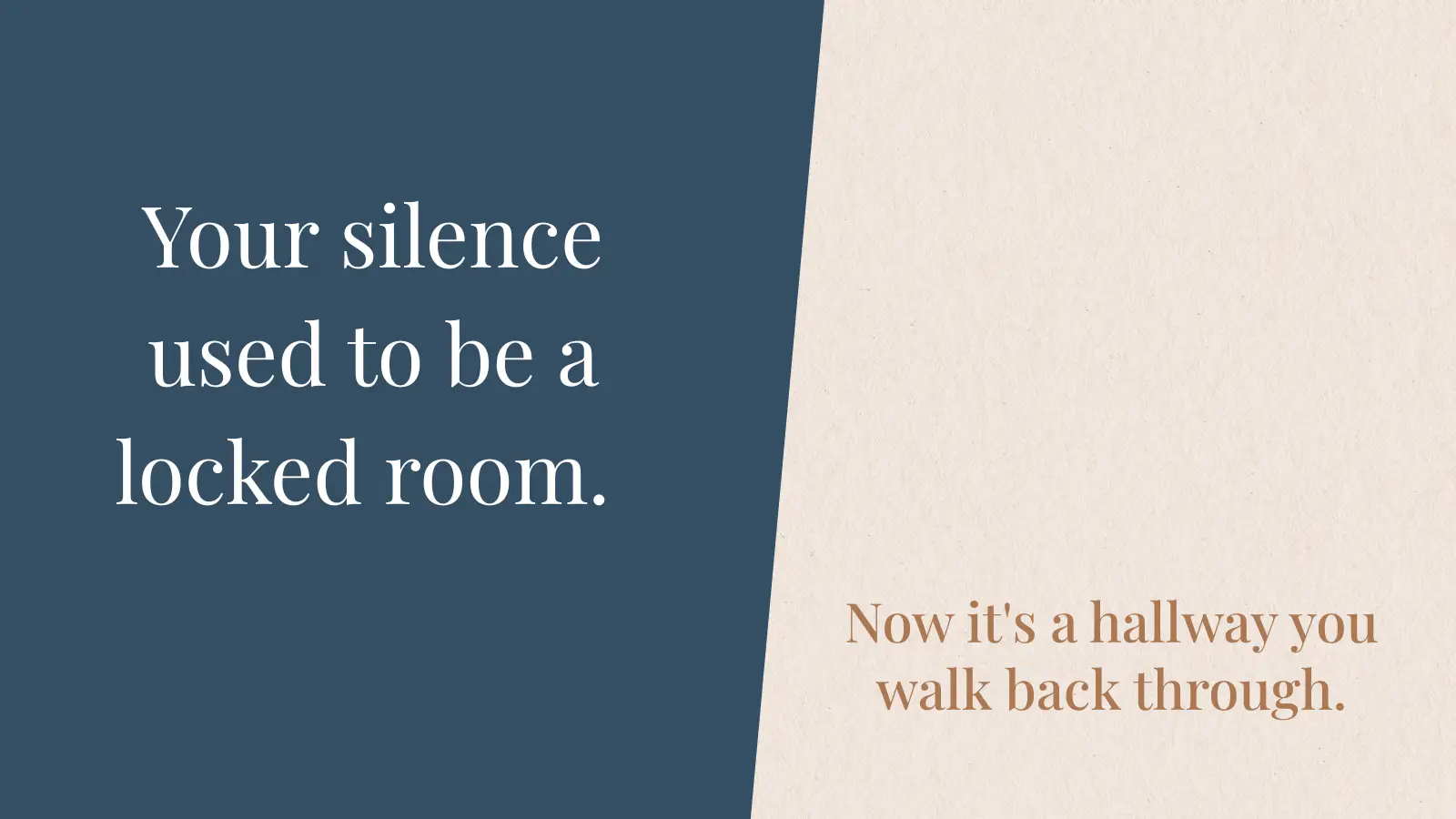
For men who need a break during conflict without it reading as stonewalling.
14 min read
You're trying to figure out how to pause an argument without going cold, because the last time you stepped away, she didn't see a man protecting the conversation. She saw a man leaving it. That gap between what you meant and what she felt is the whole problem, and it's fixable.
Key Takeaways:
put this into practice
Use these companion tools below when you are ready to have your real conversations.
what's on the line
Here's the pattern. An argument heats up. You feel your chest tighten and your thoughts go blank. You go quiet, maybe leave the room, and tell yourself you're just avoiding saying something you'll regret.
She doesn't see a man being careful. She sees a man disappearing mid-sentence. And she has no way to tell the difference between "I need twenty minutes" and "I'm done talking to you tonight," because you haven't told her which one it is.
Going quiet without naming it doesn't just end the argument. It teaches her that raising a hard topic with you means losing you for the rest of the night. Over time she stops raising things at all, and the distance stops being about one fight and starts being about the whole relationship.
This is why learning how to pause an argument without going cold matters more than winning the argument itself. A pause that's named keeps the door open. A pause that isn't named closes it, even if you only meant to step out for a minute.
why you shut down
Your reaction under stress is a leftover setting, not a character flaw. Somewhere along the way, going quiet worked. Maybe it kept the peace in a loud household growing up. Maybe an old girlfriend or a parent punished you for pushing back, so silence became the safe move. Maybe you just learned that once things get heated, nothing good comes out of your mouth, so better to say nothing at all.
That instinct made sense once. It's just badly matched to the relationship you're in now.
Here's the physical part. When you feel attacked or overwhelmed, your heart rate climbs, your jaw tightens, and your ability to think clearly drops fast. Gottman's research calls this flooding, a heart rate spike that makes calm, reasonable conversation almost impossible until your body settles back down. It usually takes close to twenty minutes for your system to reset, not two.
Feeling this way isn't the mistake. What you do next is where it goes wrong. They either push through the conversation while still worked up and say something sharp they don't mean, or they go quiet with no explanation and let her fill in the blank herself. Both options cost you. Almost nobody taught you how to take a break during an argument the third way, the one where you name it and come back.
the method
This is the whole method in four moves. It works whether you're mid-conversation or you can already feel yourself starting to shut down.
Step 1 - Name it out loud. Say what's happening in your body, not what's wrong with the conversation. "I'm starting to shut down" beats silence every time.
Step 2 - Give a specific return time. Not "later." Not "in a bit." A number. Twenty minutes. An hour. After dinner. Vague time frames read as an excuse. Specific ones read as a plan.
Step 3 - Honor the time you gave. If you said twenty minutes, come back in twenty minutes, even if you don't feel fully ready. Being on time matters more than having the perfect thing to say.
Step 4 - Re-open the conversation yourself. Don't wait for her to bring it back up. Walk back in and restart it, even briefly. This is the step most men skip, and it's the one that rebuilds trust.
Miss step 4 and the whole method collapses into a longer, quieter version of the same stonewalling you were trying to fix.
what to say
Scenario: You feel your chest tighten and your answers getting shorter. You know the shutdown is coming before it fully takes hold.
Setup: Catch it early. This script works best in the first minute of feeling overwhelmed, not after you've already gone silent for five minutes.
"I can feel myself starting to shut down."
[Pause. Keep your voice even, not clipped.]
"I need twenty minutes to reset. I'll come find you when the time's up."
Why it works: It names the internal state instead of hiding it, and it gives her a number instead of a mystery.
What happens next: She may still feel frustrated in the moment, but she has something concrete to hold onto instead of silence to interpret on her own.
Scenario: The conversation has already gotten heated and you're about to walk away.
Setup: Say this before you leave the room, not from the doorway on your way out.
"I want to keep talking about this. I just can't do it well right now."
[Pause.]
"Give me until 8:30. I'll come back and we'll finish this."
Why it works: This works because it tells her you're protecting the conversation, not ending it. Plain silence can feel like you've already checked out for the night. A specific return time replaces that guess with a plan.
What happens next: Set a phone alarm if you have to. Coming back exactly when you said you would does more for trust here than any apology later.
Scenario: Your chest is tight and your head is too loud to speak clearly, or you're not in the same room anymore and the conversation is happening over text.
Setup: Use this when talking out loud isn't working, but going silent isn't an option either.
"I'm too worked up to talk right now and I don't want to say something I don't mean."
"I want to finish this conversation. Can we pick it back up tonight after the kids are down?"
Why it works: A text gives you time to steady your thoughts without leaving her with nothing at all, a bridge rather than an exit.
What happens next: Follow through on the time you named in the text, exactly the way you would in person.
Scenario: Your return time has arrived and you need to restart the conversation instead of waiting to see if she brings it up.
Setup: Come find her. Don't wait in the next room hoping she'll come to you.
"Okay, I'm back. I've had time to think and I want to hear the rest of what you were saying."
Why it works: Re-opening the conversation yourself is the single move that separates a healthy pause from stonewalling. It proves the twenty minutes was about resetting, not escaping.
What happens next: She may test you a little at first, checking whether you're really back or just going through the motions. Stay in it.
Scenario: You already went cold without naming it, and now there's distance from a pause that didn't go the way you meant it to.
Setup: Don't wait for the next fight to bring this up. Address it directly, on its own.
"I went quiet last night and didn't explain why. That wasn't fair to you."
[Pause.]
"Next time I need space, I'll tell you and give you a time I'll be back."
Why it works: Naming the mistake without excuses shows her the pattern is changing, not just being explained away.
What happens next: This is also where you get to practice the method itself, before you need it in the heat of a real argument.
your communication style
reading her response
when it's more than one fight
Everything above works for a single tense conversation. But if going cold has been your default for months or years, one good script won't undo it in a night. That takes a different kind of rebuild, and it starts by admitting the overwhelm was real, not something to just push through this time either.
Start smaller than you think you need to. Instead of promising a full conversation, offer a short, low-stakes check-in: five minutes, one topic, nothing heavy. A text that says "thinking about you, how was your day" counts. So does sitting in the same room without your phone for twenty minutes.
These aren't consolation prizes. They're proof, in small doses, that you're capable of staying present. Trust that's been worn down by a long pattern of silence doesn't come back from one big gesture. It comes back from a string of small ones that don't get skipped.
If limited engagement is genuinely all you can manage right now, say so plainly. "I know I've gone quiet for a long time. I can't fix that tonight, but I can sit with you for twenty minutes without leaving." That's a real start, even if it doesn't feel like enough yet.
when it goes sideways
Sometimes the pause doesn't land the way you planned. She might say something like "This is just you shutting me out again, don't dress it up with a script." Don't defend the method. Say: "You're right that I've done this badly before. I'm asking you to give this one a chance. I'll be back at 8:30."
If you miss your own return time, even by ten minutes, name that too the second you're back. "I said 8:30, it's 8:45, that's on me." Small broken promises here do more damage than the original pause ever would.
If she won't accept a pause at all and keeps pressing while your heart is still racing and your thoughts are jammed, it's fine to say so directly. "I'm not going to be able to think straight if we keep going right now. I still want to finish this." From her side, this may sound like you're avoiding her rather than protecting the conversation, especially if pauses have gone badly before. Staying calm and repeating the return time, without raising your voice to prove your point, is what eventually rebuilds that trust.
the intimacy payoff
Learning how to pause an argument without going cold changes more than how your fights end. It changes what she expects from you the next time things get hard.
When you name the pause and come back, something starts to shift for her. She stops bracing for the silent treatment every time a hard topic comes up, and she starts believing you'll stay in the relationship even when a conversation gets uncomfortable. That belief is what makes room for warmth again, a hand on your arm, wanting to be physically close after a fight instead of sleeping on opposite sides of the bed.
None of this happens because you won the argument. It happens because you proved, in a small and repeatable way, that a hard conversation with you doesn't mean losing you for the night.
how to know it worked
Did your partner seem more or less defensive after you used this script?
terms used in this guide
go deeper
Note: This content is educational and not a substitute for therapy or professional advice. If the conversation involves coercion, fear, ongoing emotional harm, or safety concerns, seek support from a qualified professional.
Based on what you just read, these related guides may also be helpful.
Get the weekly script
Get one practical script each week for handling a difficult moment involving conflict, intimacy, rejection or repair. Each email gives you the words to use, why they work and when to try them.
Share respectfully below. Comments are moderated before appearing.
No credit card required.