
How to Stop Going Silent When She Needs You Most
Stay present during conflict for men who freeze up when conversations get hard
16 min read
If you want to stop shutting down in arguments, the first thing to understand is that your silence isn’t doing what you think it’s doing. You go quiet because it feels safer than saying the wrong thing. But the moment she needs you most is usually the exact moment you disappear behind your own eyes, and she can tell the difference between a man who’s calm and a man who’s gone.
Key Takeaways:
- Learn to catch the exact moment your body decides to go quiet, before the shutdown fully takes over.
- Use a short, real script that keeps you in the room even when you haven’t found the right words yet.
- Turn the minutes after a hard conversation into the start of real closeness instead of another silent stretch.
TURN INSIGHT INTO ACTION
This guide gives you the understanding.
Below are practical tools to help you as you work through the topic.
- Playbook: for step-by-step practice
- Checklist: to keep handy during a real conversation
- Quiz: to identify your communication pattern
- AI Coaching: to help you rehearse, reflect and stay on track
AI COACHING
Staying Present Instead of Going Silent
If you are already using AI, try the prompt that asks about your specific
relationship. The advice will reflect your individual situation, not
someone else’s.
what’s happening here
Why This Feels So Personal
You’re not choosing to shut down. It happens fast, usually right as the conversation gets real, right when she’s finally telling you what’s bothering her most. One second you’re listening. The next, you’re somewhere behind your own face, nodding, saying less, waiting for it to be over.
This pattern rarely starts in your marriage. Most men who stop shutting down in arguments trace it back further: a house where speaking up got you punished, mocked, or ignored, so silence became the safest move you had. Or a past relationship where every word you tried made things worse, so you learned that saying nothing was the only way to stop the damage. Either way, silence became protection, not weakness.
The problem is that the thing that once kept you safe is now the thing costing you the closeness you want. She’s not asking you to be a different person. She’s asking to see the one who’s still in the room.
the reframe
What Your Silence Is Doing
In your head, going quiet is you being careful. You’re not yelling, not saying something you’ll regret, not making it worse. From where you’re sitting, that looks like restraint.
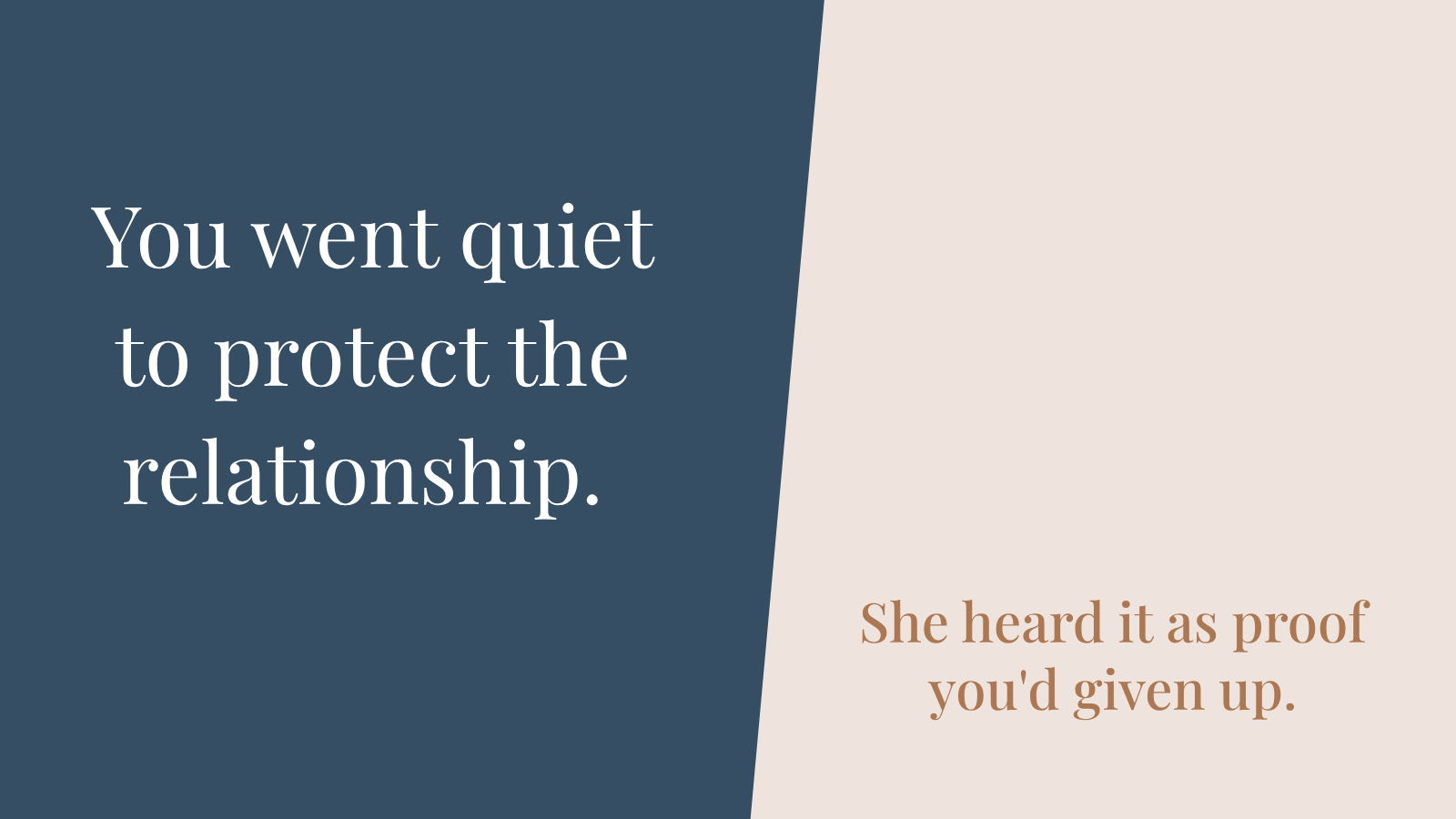
From where she’s sitting, it looks like abandonment. Silence doesn’t read as calm. It reads as absence. She’s still in the room, still trying, and the man across from her has checked out mid-sentence.
Here’s the part that matters most if you want to stop shutting down in arguments: going quiet doesn’t prevent the fight from getting worse. It just delays it and adds a second injury on top of the first, the sense that when things got hard, you left her alone in it.
A conflict, handled differently, isn’t just something to survive. It’s one of the few moments where she gets real proof that you’re willing to stay when it’s uncomfortable. That’s what builds the kind of trust that leads back to warmth, not the absence of conflict.
what’s happening in your body
What’s Happening in Your Body
Before you ever decide to go quiet, your body has already made the call. Heart rate climbs. Chest gets tight. Your jaw sets. Some men describe it as a low hum behind the ears, like the room got smaller.
Gottman calls this flooding, a physical stress response that hits somewhere around a hundred beats a minute, where your brain shifts into a mild threat state and starts treating the conversation the same way it would treat actual danger. In that state, you genuinely lose access to calm, measured language. It’s not an excuse. It’s just what’s happening under the hood.
Once you’re flooded, your brain also starts filling in gaps with the worst version of the story: she’s attacking me, she’s trying to embarrass me, this is never going to end. That’s a distortion, not a fact. Most of the time she’s not attacking you. She’s reaching for you, badly, through complaint.
Knowing this matters because it changes what you’re managing. You’re not managing her. You’re managing a body that thinks it’s under threat when it’s just uncomfortable.
the method
The Method: Staying Present Before You Say a Word
Before you worry about the perfect thing to say, you need a way to stay in your body long enough to say anything real at all. This is the order that works when you’re trying to stop shutting down in arguments, in the order you’ll use it.
Step 1 – Notice it early. Learn your own signal. Maybe it’s your jaw, your breathing, the urge to look at the floor. Catching it at the first flicker gives you options. Catching it three minutes in gives you none.
Step 2 – Name it out loud, to yourself first. Silently register “I’m starting to go quiet” instead of letting it happen on autopilot. Naming a reaction takes some of its power away.
Step 3 – Buy time without disappearing. A short, honest pause beats a silent one every time. Tell her you need a few minutes, and mean it as a pause, not an exit.
Step 4 – Come back on purpose. Set a real time to return, and be there before she has to come find you. This single move undoes most of the damage silence usually causes.
what to say
The Scripts: What to Say
These scripts are meant to be used under stress, not read out loud in a calm moment and forgotten. Pick the one that matches where you are in the conversation.
Script 1: When You Feel Yourself Starting to Go Quiet
Scenario: You’re mid-argument and you can feel the shutdown starting, the pulling back, the urge to just stop talking.
Setup: Catch it as early as you can, ideally before you’ve already gone silent for more than a few seconds.
“I can feel myself starting to shut down right now, and I don’t want to do that to you.”
Take a second before you carry on so it has time to land.
“Give me a minute to catch up so I don’t just go quiet on you.”
Why it works: You’re naming the pattern instead of performing it. She may read a sudden silence as rejection, so hearing you name it in real time gives her something other than the silence itself to respond to.
What happens next: She might soften right away, or she might need a second to hear that you’re still there. Either way, you’ve bought yourself a few more seconds without disappearing.
Script 2: When She Calls Out the Silence
Scenario: She’s noticed you’ve gone quiet and it’s making her more upset, not less. She might say something like “there you go again” or “just say something.”
Setup: Resist the urge to defend the silence or explain why you froze. Own it plainly instead.
“You’re right, I went quiet. That’s on me, not on you.”
Just breathe for a moment before you carry on.
“I’m still here. I just need a second to find the words.”
Alternate when your mind is completely blank:
“I don’t know what to say right now. That doesn’t mean I don’t care. I’m still here.”
Why it works: Owning it without a lecture stops the cycle where she pushes harder and you retreat further. A short, plain admission does more than a long explanation ever will.
What happens next: Watch for her shoulders to drop even slightly. That’s usually the first sign she’s willing to keep going instead of shutting the conversation down herself.
Script 3: Taking an Actual Break Without Disappearing
Scenario: You’re genuinely flooded, heart pounding, and you know you’re not going to be useful in the next sixty seconds.
Setup: Ask for the break out loud, with a specific time attached, instead of just walking away.
“I care about this and about you, and right now I’m too worked up to do it justice.”
“I need twenty minutes. I’m not leaving the conversation, just my body for a bit. I’ll come find you.”
Why it works: A silent exit and a named break look identical from the outside for the first ten seconds, but they land completely differently. One is disappearance. The other is a promise.
What happens next: Use the time. Walk, breathe, let your heart rate come down for real. Don’t scroll your phone and call it regulation.
Script 4: Coming Back After the Break
Scenario: Your twenty minutes are up, or close to it, and it’s time to follow through on the promise you made.
Setup: Come back before she has to check whether you meant it.
“Thanks for giving me that time. I’m in a better place to hear you now.”
“Can you tell me again what mattered most in what you were saying?”
Why it works: Returning on your own, before she comes looking, is the clearest proof that the break wasn’t an exit. That’s the thing that starts to rebuild trust in the pattern itself.
What happens next: She may repeat herself with less heat the second time. Let her. Don’t rush to defend or fix anything yet, just listen.
Script 5: The Next-Day Repair
Scenario: Last night went badly. You shut down anyway, or the break turned into silence for the rest of the evening.
Setup: Bring it up yourself. Don’t wait for her to raise it or decide it’s not worth mentioning.
“I’ve been thinking about last night. I went quiet again, and I know that’s hard on you.”
“I want to try this differently. Can we finish the conversation we didn’t get to?”
Why it works: Bringing it up first tells her the pattern isn’t invisible to you anymore. That single move often matters more than getting every word of the actual repair perfect.
What happens next: She may test you a little, bring up other times this happened. That’s not her punishing you, it’s her checking whether this is real before she lets her guard down again.
what makes it worse
Mistakes That Undo Your Progress to Stop Shutting Down in Arguments
These are the moves that feel like progress but usually work against you if you’re trying to stop shutting down in arguments.
- Turning “I need space” into a permanent exit. A break with no return time is just silence with better branding.
- Apologizing without changing anything concrete. “Sorry, I do that sometimes” isn’t a repair. A specific script or a specific plan is.
- Waiting for her to come to you first. The longer the gap sits unaddressed, the more it confirms her worst read of the pattern.
- Using your history as an excuse instead of an insight. “I shut down because of my dad” explains the pattern. It doesn’t replace the work of changing it.
how this plays out
How This Plays Out
Mark and his wife had been arguing about money for ten minutes when she said, “you always do this, you just check out.” Six months ago, he would have gone quiet and let her walk away frustrated. This time, he caught it early enough to say he was starting to shut down, and asked for a few minutes. He came back in fifteen. It wasn’t a perfect conversation, but it was the first one in months that didn’t end with her sleeping on the far edge of the bed.
Dave’s version looked different. He didn’t catch it in time, went silent through the whole fight, and woke up the next day still not sure what to do. Instead of letting it sit, he brought it up over coffee before either of them left for work. That single move, raising it himself, was enough to keep the door open for the rest of the week.
your communication style
How This Looks Different Depending on Your Pattern
The freeze doesn’t look the same on every man trying to stop shutting down in arguments. Find the version that matches you.
If you tend to agree and go along just to keep things calm
Your version of shutdown is quieter and harder to spot. You say “I’m fine” and mean the opposite, then the resentment builds underneath while you stay physically present but emotionally gone. She may read your agreement as honesty when it’s avoidance, so the closeness she thinks she’s getting isn’t real. Try naming one true thing you feel, even a small one, instead of defaulting to agreement.
If your first move is to explain or defend your side
You don’t go silent right away. You go silent after you’ve already argued your case and it hasn’t worked, and the shutdown looks like giving up rather than freezing. Try pausing before the defense, not after it. A single “you’re right that hurt you” before you explain anything changes how the whole conversation goes.
If your voice or pace picks up before you even notice it
Your shutdown often follows a spike, not the other way around. You get loud or intense, she pulls back scared, and then you go quiet out of guilt or exhaustion once the intensity burns off. Try catching the volume climb itself. Lowering your voice on purpose, mid-sentence, does more for this pattern than almost any script.
If your body pulls you out of the room before your mind catches up
This is the classic version, the one this guide is built around. You go quiet fast, sometimes before you’ve registered what you’re feeling at all. The method above, catching it early and naming it out loud, is built specifically for this pattern. Start there.
how she may respond
How to Adapt to Her Likely Response
How you handle the moments after a freeze also depends on how she tends to respond when you go quiet.
before you start
Solo Practice: Before the Next Hard Conversation
Some of the work to stop shutting down in arguments happens before any conflict starts.
- Spend five minutes naming your own early-warning signs, jaw, breath, the urge to look away, so you can catch them faster next time.
- Picture the last time you shut down and rerun it in your head, this time saying the first script out loud instead of going quiet.
- Ask yourself what you’re afraid will happen if you stay present. Write down the answer. Most of the time it’s a fear, not a fact.
when it goes sideways
When It Goes Sideways
Sometimes even with all of this, it still goes badly. She might snap back with something like “don’t tell me you’re fine, you always say that and then disappear anyway.”
Don’t defend your history with her. Don’t argue that this time is different. Just stay with it plainly: “You’re right to be skeptical. I haven’t always followed through. I still want to try. Can we talk again tonight?”
If she pulls away completely in that moment, let her. Chasing her right then usually adds pressure instead of comfort, especially when she’s guarding herself against getting her hopes up again. Follow up later, at the time you said you would, and keep following through until the pattern itself starts to feel believable to her.
the intimacy payoff
The Intimacy Payoff
None of this is really about winning the argument. It’s about what happens after.
When you stay present instead of disappearing, something small but real shifts. She stops bracing for the version of you that goes quiet and never comes back. That safety is what clears space for warmth, a hand on your arm, sitting closer on the couch, wanting to be near you again instead of guarding against you.
That’s the real reason to stop shutting down in arguments: not to win the fight, but to stay close enough afterward for things to soften.
What she may be protecting, underneath the frustration about your silence, is her own willingness to stay open at all. Every time you come back on purpose, that willingness gets a little easier for her to access. That’s the actual bridge between fewer silent nights and more of the physical closeness you’re both missing.
how to know it worked
THE SUCCESS CHECK
- You caught the urge to go quiet before it fully took over, at least once.
- You came back from a break on your own, before she had to ask where you’d gone.
Did your partner seem more or less defensive after you used this script?
terms used in this guide
Glossary
- Flooding: The physical stress response, heart racing and thinking narrowing, that makes calm conversation nearly impossible in the moment.
- Stonewalling: Gottman’s term for shutting down completely during conflict, going quiet and physically or emotionally checking out.
- Repair attempt: Any small word or gesture, a joke, an apology, a hand reaching out, meant to de-escalate tension before it spirals.
when you want to dig deeper
References & Books
- The Seven Principles for Making Marriage Work. Gottman, J. M., & Silver, N. (1999/2015). Harmony Books. Lays out the Four Horsemen and the repair habits that keep small fights from becoming permanent distance. Source link | Amazon
- The Marriage Clinic: A Scientifically Based Marital Therapy. Gottman, J. M. (1999). W. W. Norton & Company. Explains the physiological flooding response behind shutdown and the research on why a real break, not a silent exit, protects the conversation. Source link | Amazon
- Attachment in Adulthood: Structure, Dynamics, and Change. Mikulincer, M., & Shaver, P. R. (2007). Guilford Press. Details how withdrawal can function as a self-protective strategy in adult relationships, useful for understanding why the freeze feels protective even when it isn’t. Source link
AI COACHING
Ready to Work This Through?
Use the AI Coaching Companion to rehearse what you want to say,
question your assumptions and prepare for the real conversation.
KEEP GOING
Choose Your Next Step
Use the Playbook for step-by-step practice, keep the Checklist handy
during a real conversation, or take the Quiz to identify your
communication pattern.
Your Questions Answered
Frequently Asked Questions
How do I stop shutting down in arguments and start rebuilding physical closeness afterward?
Catching the freeze early and asking for a short, specific break instead of going silent is the fastest way to stop shutting down in arguments. When you come back on your own, before she has to ask, it tells her you’re staying instead of disappearing. That’s usually what opens the door back to touch and closeness, not the argument itself getting resolved perfectly.
Why do I go quiet during conflict and how does it affect our sex life?
Going quiet during conflict usually reads to her as absence, not calm, and that sense of distance carries into the bedroom too. When she doesn’t feel emotionally safe with you, physical closeness tends to shut down along with the conversation. Staying present, even briefly, is often the first step back toward a more active sex life.
What can I say after a fight to bring back affection instead of distance?
A short, honest line works better than a big gesture right after a fight. Something like “I went quiet, and that’s on me” opens more space for affection than silence or a vague apology ever will. Saying it soon, ideally within a day, matters more than saying it perfectly.
Why does going silent make her stop initiating sex or touch?
When you go silent instead of staying present, she often stops reaching for you physically because she doesn’t feel safe initiating. It’s rarely about attraction fading, it’s about her protecting herself from being met with more silence. Once you show her you’ll stay through hard conversations, initiating touch usually starts to feel safer for her again.
How long does it take for physical closeness to come back after I stop shutting down in arguments?
There’s no fixed timeline, but small, consistent follow-through tends to matter more than one perfect conversation. Most men notice small signs of warmth, a hand on the arm, sitting closer, within days once they stop shutting down in arguments and start returning from breaks on their own. Full physical closeness usually rebuilds gradually, not all at once.
Note: This content is educational and not a substitute for therapy or professional advice. If the conversation involves coercion, fear, ongoing emotional harm, or safety concerns, seek support from a qualified professional.
Have a thought or questions about this guide?
Share respectfully below. Comments are moderated before appearing.