
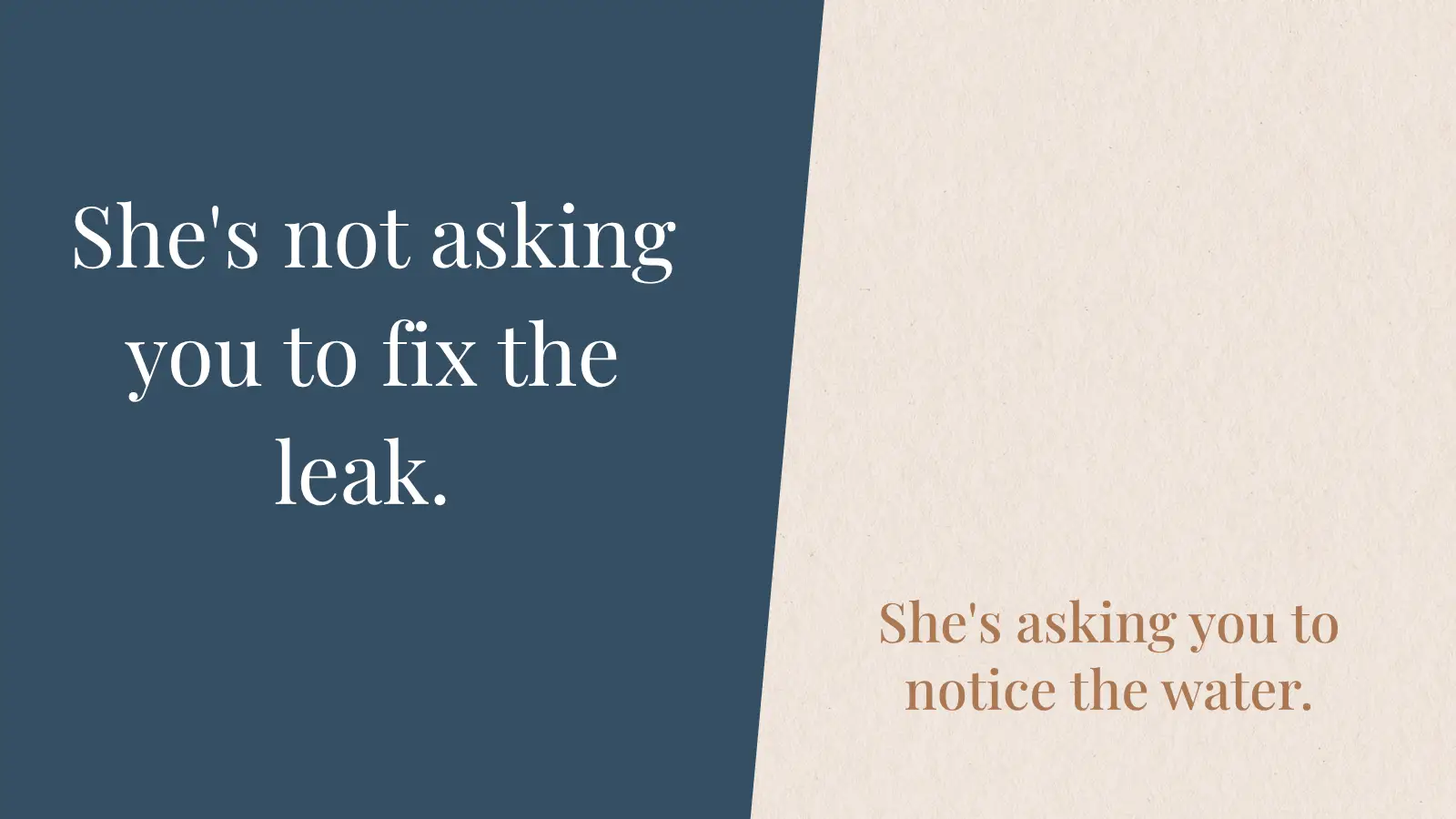
When You Want to Fix It But She Needs You to Listen
Practical phrases for men who care deeply but keep getting it wrong in hard moments
12 min read
She starts telling you about something that’s bothering her, and by the fourth sentence you already have a plan. Learning to stop fixing and start listening isn’t about staying quiet or having no opinion. It’s about giving her what she’s asking for before you give her what you think she needs.
Key Takeaways:
- Ask one question before you offer one solution.
- Repeat back what you heard, in your own words, before you respond with anything else.
- Save your advice for the moment she asks for it, not the moment you think of it.
TURN INSIGHT INTO ACTION
This guide gives you the understanding.
Below are practical tools to help you as you work through the topic.
- Playbook: for step-by-step practice
- Checklist: to keep handy during a real conversation
- Quiz: to identify your communication pattern
- AI Coaching: to help you rehearse, reflect and stay on track
AI COACHING
Listening Instead of Fixing When She Vents
If you are already using AI, try the prompt that asks about your specific
relationship. The advice will reflect your individual situation, not
someone else’s.
why this happens
Why You Jump Straight to Solutions
Most men who fix instead of listen learned it as a survival skill, not a character flaw. If you grew up in a house where feelings caused problems and solving them made things calm again, jumping to a fix is how you learned to keep the peace. Maybe you were the kid who got praised for having an answer and ignored when you just had a feeling.
Now, when she brings you a problem, your brain still runs the old program: find the fix, restore the calm, move on. It made sense once. It doesn’t work the same way with her.
If you’ve searched for how to stop trying to fix your wife’s problems late at night after a conversation went sideways, you’re not alone, and it doesn’t mean you don’t care.
the real ask
What She’s Really Asking For
When she vents, she’s usually not asking you to solve anything. She’s checking whether you’re still paying attention to her life. Researchers call this a bid for connection, a small reach toward you to see if you’ll turn toward her or turn away.
A fast solution is one way of turning away, even when you mean it as help.
why fixing backfires
Why Your Solution Feels Like an Interruption, Not Help
Here’s what happens on her end. She’s mid-sentence, working through how she feels, and you cut in with an answer. To you, that’s efficient. To her, it feels like you decided the conversation was over before she was done having it.
Her shoulders tighten. She stops elaborating. She might even apologize for bringing it up at all, which is the opposite of what either of you wants.
You’re not wrong that you have good ideas. You’re early. Timing is the whole problem.
the method
How to Stop Fixing and Start Listening
This is the order that works, in four steps. Most men skip straight to step four. That’s the mistake.
Step 1 – Catch the Urge. The second you feel a solution forming, notice it. That urge is information, not an instruction. You don’t have to act on it right away.
Step 2 – Ask Before You Assume. Before you respond, ask her directly whether she wants you to listen or help. This single question saves both of you from guessing.
Step 3 – Reflect It Back. Say what you heard in your own words. Not a summary of the facts, a summary of how it sounded like she felt.
Step 4 – Earn the Right to Weigh In. Once she’s said what she needed to say and you’ve reflected it back, ask if she wants your take. If she says yes, offer it briefly. If she says no, let it go.
what to say
What to Say When She’s Venting
Catching Yourself Mid-Fix
Scenario: She’s telling you about a frustrating situation with her sister, and you feel the pull to offer a solution.
Setup: Notice the pull, and pause before you speak.
“Wait, before I say anything else, let me make sure I heard you right.”
[Pause.]
“Keep going. I’m listening.”
Why it works: You’re naming the pause out loud instead of silently rehearsing a fix, which keeps her from feeling like she lost your attention.
What happens next: She usually keeps talking, often with more detail than before, because she can tell you’re not waiting for your turn.
The Reflective Listening Script
Scenario: She finishes describing a hard day and looks at you, waiting.
Setup: Reflect what you heard before you respond with anything else.
“So today felt like nobody had your back, and you’re worn out.”
[Pause.]
“Did I get that right?”
Why it works: Reflecting her words back proves you were tracking her feelings, not just the facts of the story.
What happens next: She either confirms it and keeps talking, or corrects you, which tells you exactly what she still needs you to understand.
| Style | Your Likely Reflex | Try This Instead |
|---|---|---|
| Connector | You nod along and say nothing, hoping it passes | Reflect what you heard out loud, even one sentence |
| Defender | You explain your side of a related issue | Reflect her point before you mention yours |
| Escalator | You match her energy and get worked up too | Lower your volume and reflect calmly |
| Withdrawer | You go quiet and let the moment pass | Reflect briefly, even if you need a moment to find the words |
Asking Permission to Problem-Solve
Scenario: You genuinely have an idea that could help, and you’re not sure if she wants it yet.
Setup: Ask directly instead of guessing.
“Do you want me to just listen right now, or do you want ideas too?”
[Pause.]
“Either one is fine. I just want to give you the right thing.”
Why it works: You hand her the choice instead of deciding for her, which lowers her guard immediately.
What happens next: Most of the time she’ll tell you straight, and you’ll stop guessing wrong.
When She Calls You Out for Not Listening
Scenario: She says something like “You’re not even listening” partway through a conversation.
Setup: Don’t defend yourself. Reset instead.
“You’re right, I jumped to fixing it again. Give me another shot at just listening.”
[Pause.]
“Go ahead, I’m not going to interrupt.”
Why it works: Agreeing with her read on the moment, instead of arguing about your intentions, is what gets you back on track.
What happens next: She usually softens within a sentence or two, once she sees you correct course instead of defend it.
The Repair After You’ve Already Started Fixing
Scenario: Two minutes into listing solutions, you notice her face has closed off.
Setup: Stop, name it, and hand the floor back to her.
“I just noticed I’ve been trying to solve this instead of hearing you out.”
[Pause.]
“Can you back up and tell me the part I missed?”
Why it works: Naming your own slip removes the need for her to point it out herself, which is usually where the real friction starts.
What happens next: She’ll often pick the conversation back up exactly where she felt unheard.
where this goes wrong
Where This Goes Wrong
- Interrupting her mid-story because you already know what you’d do.
- Minimizing what she’s feeling (“It’s not that big a deal”) instead of naming it.
- Getting short with her when she doesn’t seem grateful for the fix you offered.
- Turning her feeling into a debate about facts, like arguing over whether her sister “really” meant it that way.
- Offering advice as a way to end the conversation faster, then wondering why she feels more distant, not less.
your communication style
How to Adjust Based on Your Own Reaction
If your instinct is to stay quiet and just wait for it to pass, that’s not the same as listening, even though it looks calm from the outside. She may read your silence as checked out, not patient. Say one thing out loud, even just repeating her last sentence back to her, so she knows you’re still with her. That single sentence is often what lets her keep talking instead of changing the subject.
If your first move is to explain what you already did or point out the part of the story that’s not fair to you, she stops mid-sentence and shifts into defending herself instead of finishing what she was saying. Save your side of it for after you’ve reflected hers. Once she feels heard, she’s usually far more willing to hear your part too.
If you feel your energy rising to match hers, that intensity reads as pressure, not partnership, even when you’re on her side. Slow your voice down and reflect what she said at half the volume. When you regulate first, she stops bracing for an argument and starts treating you like someone safe to be upset in front of.
If your instinct is to go quiet and leave the room, this can feel like abandonment to her, in the middle of something that mattered, even if you just needed a minute. Stay in the room, even without words, and tell her you’re not leaving the conversation. That small act of staying is often what lets her reach for you later instead of shutting the door for the night.
her pattern
How to Adapt Based on How She Responds
when it goes sideways
If the Conversation Already Went Sideways
If you already gave the whole conversation over to problem-solving and she’s gone quiet since, don’t wait for her to bring it up again. She may read that silence as you not caring, even if that’s not what happened. A same-day repair works better than a perfect apology three days later.
Try something like: “I’ve been thinking about earlier. I jumped straight to fixing it instead of just listening to you. Can we try that conversation again?”
She might take you up on it right away, or she might need until tomorrow. Either way, you’ve told her you noticed, which matters more than getting the timing exactly right.
before you start
Before You Try This
- Notice the next three times you feel the urge to jump in with an answer, and just name it to yourself: “There’s the fix reflex.”
- Practice this on something low stakes first, like a coworker complaint or a customer service problem, before you use it in a hard conversation with her.
- Decide ahead of time on one line you’ll use to ask permission, so it’s ready before you need it.
the intimacy payoff
What Changes When You Do This
When you listen before you fix, the shift she notices first is small. Her sentences get longer instead of shorter. She stops saying “never mind” and finishes her thought instead.
Over the next few days, that shows up as her bringing you more, not less: a story from her day, a worry she’d normally sit on alone, her hand finding yours on the couch without either of you making a thing of it.
None of that happens because you solved a problem. It happens because you proved you’d rather sit with her in it than rush her out of it. This is what stop fixing, start listening means in practice, not once, but consistently.
how to know it worked
THE SUCCESS CHECK
- She keeps talking instead of trailing off with “never mind” or “forget it.”
- Her posture softens: arms uncross, she leans toward you, or she reaches for your hand while she’s still talking.
Did your partner seem more or less defensive after you used this script?
when you want to dig deeper
References & Books
- The Seven Principles for Making Marriage Work. Gottman, J. M., & Silver, N. (1999/2015). Harmony Books. Explains the research behind bids for connection, and why turning toward a small reach for attention matters more than solving the problem behind it. Source link | Amazon
- Nonviolent Communication: A Language of Life. Rosenberg, M. B. (2003/2015). Puddledancer Press. Lays out the observation, feeling, need, request model that supports reflecting her feelings back before responding with your own. Source link | Amazon
AI COACHING
Ready to Work This Through?
Use the AI Coaching Companion to rehearse what you want to say,
question your assumptions and prepare for the real conversation.
KEEP GOING
Choose Your Next Step
Use the Playbook for step-by-step practice, keep the Checklist handy
during a real conversation, or take the Quiz to identify your
communication pattern.
Your Questions Answered
Frequently Asked Questions
Does learning to stop fixing and start listening bring back physical affection?
Yes, but it’s not instant. When you listen before you jump to solutions, she feels less alone with what she’s carrying, and that safety is usually what opens the door back to touch and affection. Most men notice small signs first, longer sentences from her, a hand finding yours on the couch, before anything bigger shifts. Give it a few real conversations before you judge whether it’s working.
What should I say when she’s venting so she wants to be close to me again?
Ask her directly if she wants you to listen or offer ideas, then reflect back what you heard before you say anything else. Something as simple as, “Do you want me to just listen right now, or do you want ideas too?” works well. That question alone tells her you’re paying attention to her, not just to the problem, which is often what makes her want to sit closer to you.
Why does she pull away from sex when I keep trying to fix her problems?
When you keep offering solutions, she can start to feel managed instead of understood, and that distance often shows up in the bedroom too. Feeling unheard during hard conversations tends to carry into everything else, including how safe she feels being physical with you. Slowing down and listening first is usually what closes that gap again.
What if I say the wrong thing and she pulls further away from intimacy?
If you slip and she pulls back, name it directly instead of defending yourself. Tell her you jumped to fixing again and ask for another chance to just listen. Most women respond well to that kind of direct ownership, even mid-conversation. One honest reset rarely does lasting damage to how close you are.
How long before she starts initiating affection again once I stop fixing everything?
There’s no fixed timeline, and every relationship moves at its own pace. Most men notice small signs, like her staying in the room longer or reaching for his hand, within the first few real conversations. Consistency over the following weeks is usually what brings back initiating affection on her own. Keep using the method even on days it doesn’t feel like it’s working.
Note: This content is educational and not a substitute for therapy or professional advice. If the conversation involves coercion, fear, ongoing emotional harm, or safety concerns, seek support from a qualified professional.
Have a thought or questions about this guide?
Share respectfully below. Comments are moderated before appearing.